Riders · Ranchwear · Public image
Ranch & range.
The work behind the Western look
Clothes for a working day, and a public West.
The mounted cowboy in a photograph made around the turn of the twentieth century looks familiar enough to be mistaken for an explanation. The Library of Congress catalogues the picture under a simple title: A cowboy. A horse, a rider and the clothes visible between them became a compact image of the West. The Library of Congress can tell us who issued the photograph and roughly when it was made. It cannot tell us who cut the rider's clothes, whether he bought them for work, or what his neighbours would have called the outfit. The title makes a type legible; it does not give us a wardrobe history. (Source: LOC, A cowboy)
That gap is where this story begins. Western dress was shaped by riding, weather and labour, but it was also shaped by the picture taken of a rider, the rodeo that put one before an audience, and the shop that later sold a version of the look. The route from one setting to the next was not a straight line. A practical feature could become a badge of belonging or a theatrical flourish. A decorated shirt might borrow the authority of ranch work without ever having been worn to do it. To understand the clothes, we have to ask what each surviving source actually shows.
Before the label, the work
There was no single ranch wardrobe that every rider inherited unchanged. Western horse cultures developed through contact among peoples, places and materials. The National Cowboy & Western Heritage Museum traces the decorative traditions of horse and cattle gear in New Spain and colonial Mexico through Native American, European, African and Islamic influences. That is a useful correction to the idea that a ready-made cowboy outfit simply sprang from one Anglo-American frontier. It is a history of horse cultures and their material traditions, however, not proof that any particular shirt pocket or embroidered motif came from one of those communities. (Source: Caballeros y Vaqueros)
The Library of Congress's account of Northern Nevada buckaroos gives the clothes a more intimate scale. In that community, dress had practical and symbolic uses, and conspicuous finery could mark a person as an outsider. That is a regional observation, not a rule for every cattle camp or rodeo ground. It reminds us that people closest to the work did not necessarily dress like the most lavish picture later sold in their name. A hat or pair of trousers could be chosen for a task, altered through wear, and read by other workers for what it said about the person wearing it. (Source: LOC, Buckaroo clothing)
The worn garment is harder to find in a museum than the showpiece. Its maker may have been unnamed even when its wearer was photographed. A photograph can fix a moment of clothing without showing the choices made in the workroom, shop or home before that moment. The best way to respect such an image is to describe what is visible and let the missing information remain missing. There is no need to press an anonymous rider into service as a model for every cowboy who ever lived.
The rodeo changes the audience
A rodeo made riding and stock work visible to spectators. It also changed the job clothes had to do. A rider could be dressed for the event and still be performing difficult physical work, but the camera records the public setting, not the private reason for each garment choice. In Russell Lee's 1940 Quemado photograph, the catalogue locates a cowboy at a rodeo. That description is enough to put the picture in an event. It is not an invoice from a tailor, and it cannot turn a visible seam into a named maker's signature. (Source: LOC, Russell Lee, 1940)
The same distinction matters when a tailor markets to riders. In May 1944, a Billboard advertisement called the Philadelphia business “Rodeo Ben's Western Ranchwear” and printed its West Columbia Avenue address. The word Ranchwear gave the offer a working-West authority. The advertisement also made claims about craftsmanship and fame. Those were the shop's selling words, not an independent survey of who bought the clothes or how they were used. We can say that the firm offered this named line in a period trade advertisement. We cannot say that every decorated Rodeo Ben garment was made for ranch labour. (Source: Billboard, 1944)
The shop's surviving objects show why that boundary matters. The Autry Museum describes one mid-century Rodeo Ben shirt worn by Gene Autry: pink and yellow acetate, piping, a shaped breast pocket, appliquéd feathers, embroidered head motifs and rhinestones. It is a documented performer object in the museum's account, with a material and visual ambition far beyond a generic work shirt. Its decoration should be described accurately and its cultural imagery examined, rather than offered as a costume for all ranch hands. The object and the 1944 advertisement both belong to Rodeo Ben's history. They do not prove that the shirt pictured by the museum was advertised as Ranchwear, or that Autry wore it to work cattle.
Who gets called a cowgirl?
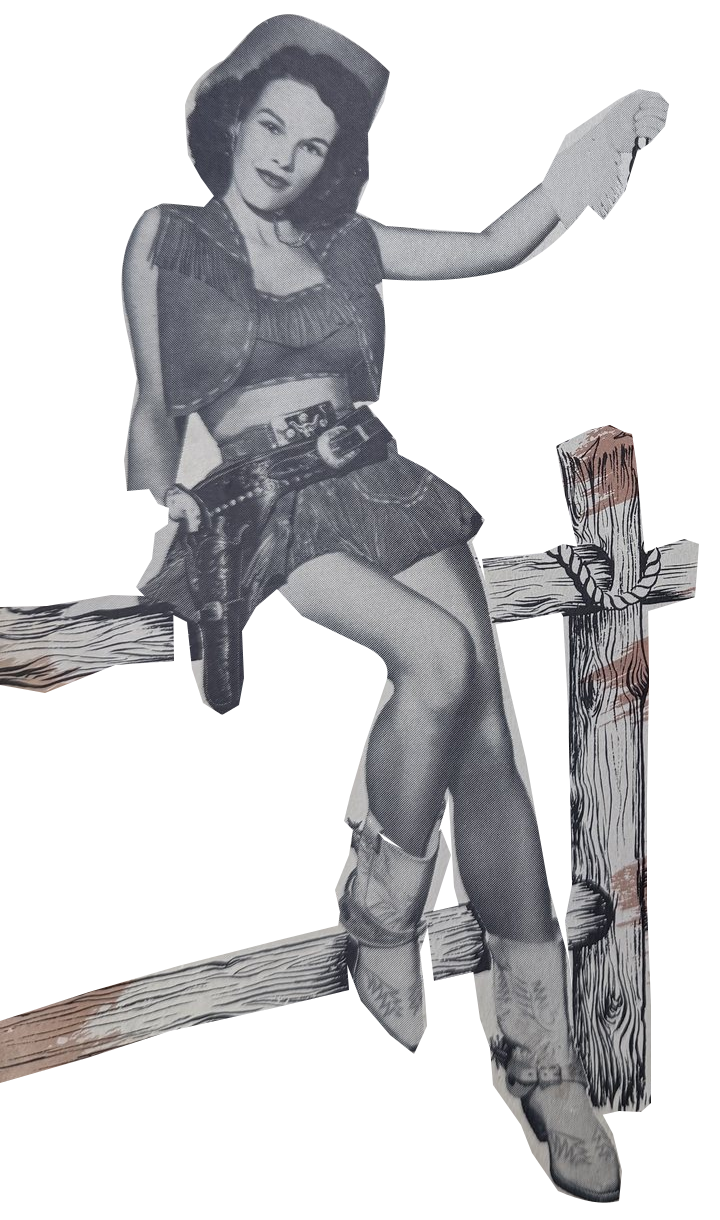
Women appear in this history through more than a counterpart to a men's outfit. In April 1940, Life ran a feature called “Cowgirl” and discussed Marge Riley's ranch clothes, Los Angeles shop and Palm Springs branch. Its pages put women's Western dress before a national magazine audience, with garments designed to be read in colour and shape. But the captions require care. The green suede split-skirt and bolero pictured on page 47 are explicitly credited to Fashion Sportswear Inc. The magazine gives Riley a broader credit for ranch clothes on pages 47 and 48, including other pictured looks; that broader wording does not transfer the green outfit to her. (Source: Life, 1940)
The distinction is more than a footnote about a caption. It lets us see an active field of women's Western clothing rather than assigning every vivid image in a feature to its best-known name. The magazine is evidence of what an editor printed and how the garments were presented. It is not a cutting-room record, an order book or a list of women who wore those clothes while working on a ranch. A divided skirt can suggest riding in its form; the magazine image alone cannot tell us what a particular wearer did in it.
There were other ways to sell the look. The Hall of Fame displays Fay Ward Company catalogue pages offering custom Western garments from a New York address. Ward's numbered designs let a customer compare yokes, pockets, fringe and prices. The company advertised complete suits and parade outfits as well as shirts. In those pages, the West became a set of choices a buyer could order from Manhattan. The catalogue shows an offer; it does not, by itself, show which design left the shop or where it was worn.
Ranchwear on a town counter
By March 1949, a Muleshoe, Texas, store could call a group of goods “Western Clothes” for visitors to its Fat Stock Show. Cobb's advertisement invited readers to see shirts, frontier pants and jackets “by H-Bar-C.” It is a small, local piece of print, but it shows the commercial machinery around the look: a named occasion, a town shop, product categories and a branded offer. It does not tell us how much stock Cobb's held, who made each garment, or whether a visitor bought one. (Source: Muleshoe Journal, 1949)
The Muleshoe ad and Rodeo Ben's Ranchwear pitch also show why labels alone cannot divide Western dress neatly into “real” and “show.” A retailer could offer clothes for a stock-show crowd. A tailor could give a line a ranch name while dressing entertainers. A magazine could call a page “Cowgirl” while drawing on more than one manufacturer. These choices were made for particular audiences. They carried the language and outline of working dress into spaces where people watched, competed, shopped and imagined themselves in the West.
That movement is the subject of this route. The ranch was a place of work, not simply the costume department for a later show. Yet the rider's image became one of the most portable designs in American commerce. A source might name a maker, a garment, a shop or an event. Sometimes it names only “a cowboy.” Read those records together and the familiar outline becomes more interesting: not one uniform travelling unchanged, but people repeatedly choosing what Western clothes could do for them.
Sources & further reading
- Library of Congress, *A cowboy*
- Library of Congress, Russell Lee, *Cowboy at rodeo, Quemado, New Mexico*
- National Cowboy & Western Heritage Museum, *Caballeros y Vaqueros*
- Library of Congress, “Clothing” in *Buckaroos in Paradise*
- *Billboard*, 27 May 1944
- Autry Museum, Rodeo Ben shirt worn by Gene Autry, object M533534
- *Life*, 22 April 1940, vol. 8, no. 17
- CMHOF, “Western Style Roundup”
- *Down Beat*, 18 November 1953
- *Country Music Who’s Who*, 1960
- Cobb’s, “Western Clothes,” The Muleshoe Journal (17 March 1949)