Some Western-wear histories arrive with a photograph, a catalogue, a family story and a label all at once. Harvey Krantz comes into view by a narrower road: a line in a trade-paper column, a named museum object, and a string of performers who turn up beside his name. That does not make the story small. It tells us where the work was being noticed, and how much of the record still waits to be recovered.
A suit for the Bicentennial summer
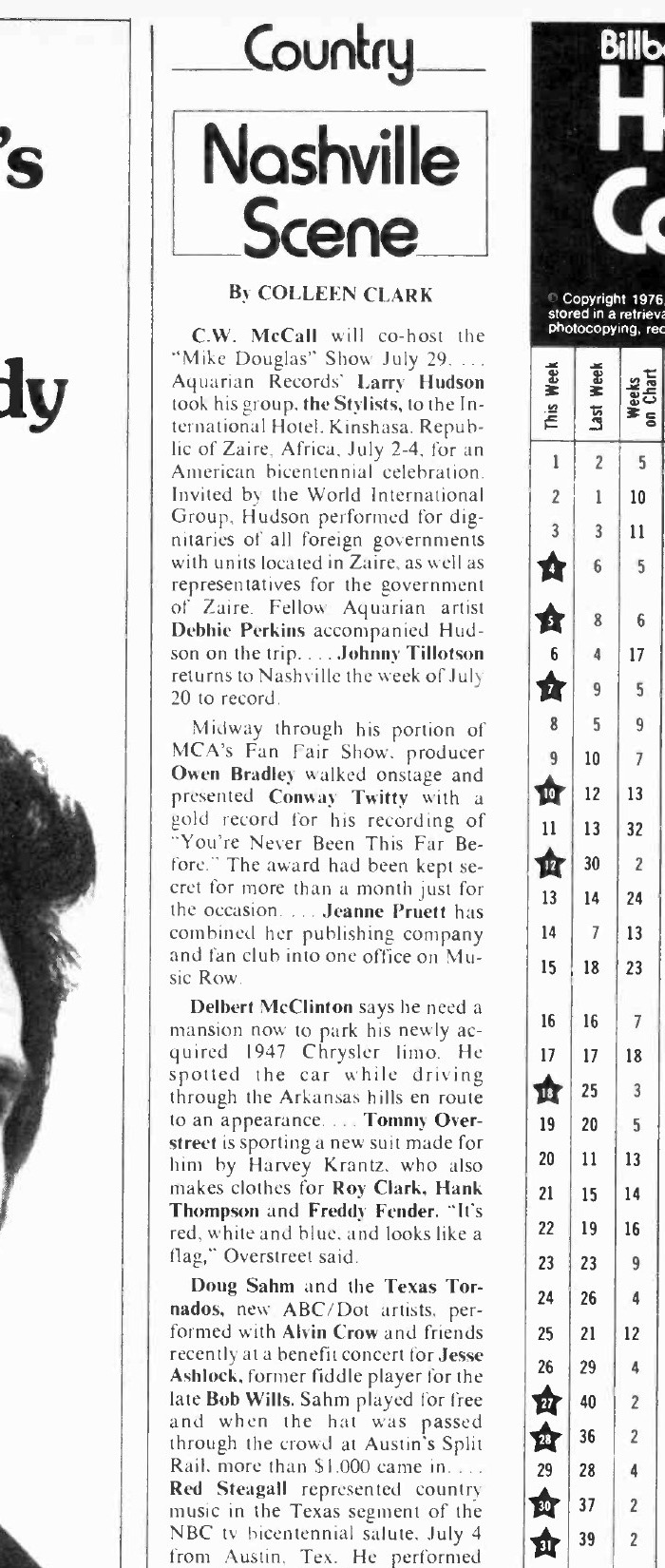
On 10 July 1976, Billboard’s Colleen Clark reported from Nashville that Tommy Overstreet was wearing a new suit made by Harvey Krantz. Overstreet described it as red, white and blue, and said it “looks like a flag.” The sentence is wonderfully compact: a performer on the road, a suit made to read from a distance, and the United States Bicentennial folded into one piece of stage clothing.1
Clark also wrote that Krantz made clothes for Roy Clark, Hank Thompson and Freddy Fender. The column is evidence of that reporter’s specific July 1976 account, rather than a complete roster or a run of contracts. Still, it puts four major country performers in the same small stretch of type and gives Krantz a firm place in the working world of Nashville costume.1
A suit in a museum record
The National Music Centre in Calgary separately catalogues a Hank Snow stage ensemble, object T.2016.35.1–3, with Harvey Krantz as the suit maker and James Leddy as the boot maker. Its record does not supply a precise year; its value is in the clear division of the ensemble between the person who made the suit and the bootmaker who made the boots.2
That division matters. A stage outfit is often remembered under a singer’s name or a tailor’s name, even when several specialists shaped what an audience saw. The Krantz record lets the suit and the boots keep their distinct authorship, and it gives future research a specific object number to pursue rather than another floating anecdote.2
The evidence in the name
The National Music Centre’s person record says that little documentation for Harvey Louis Krantz is available. Its own caution is a useful starting point. A history can acknowledge a celebrated client name without turning it into a finished biography, and a single vivid report without pretending it represents every order that went through a shop.3
For now, the strongest picture is a useful one: in the summer of 1976, a Billboard reader could learn that Tommy Overstreet’s flag-coloured suit came from Harvey Krantz, alongside named clothes for Roy Clark, Hank Thompson and Freddy Fender. It is the kind of trace that makes an archive grow: not the last word, but enough to know exactly what document, garment and label to go looking for next.1