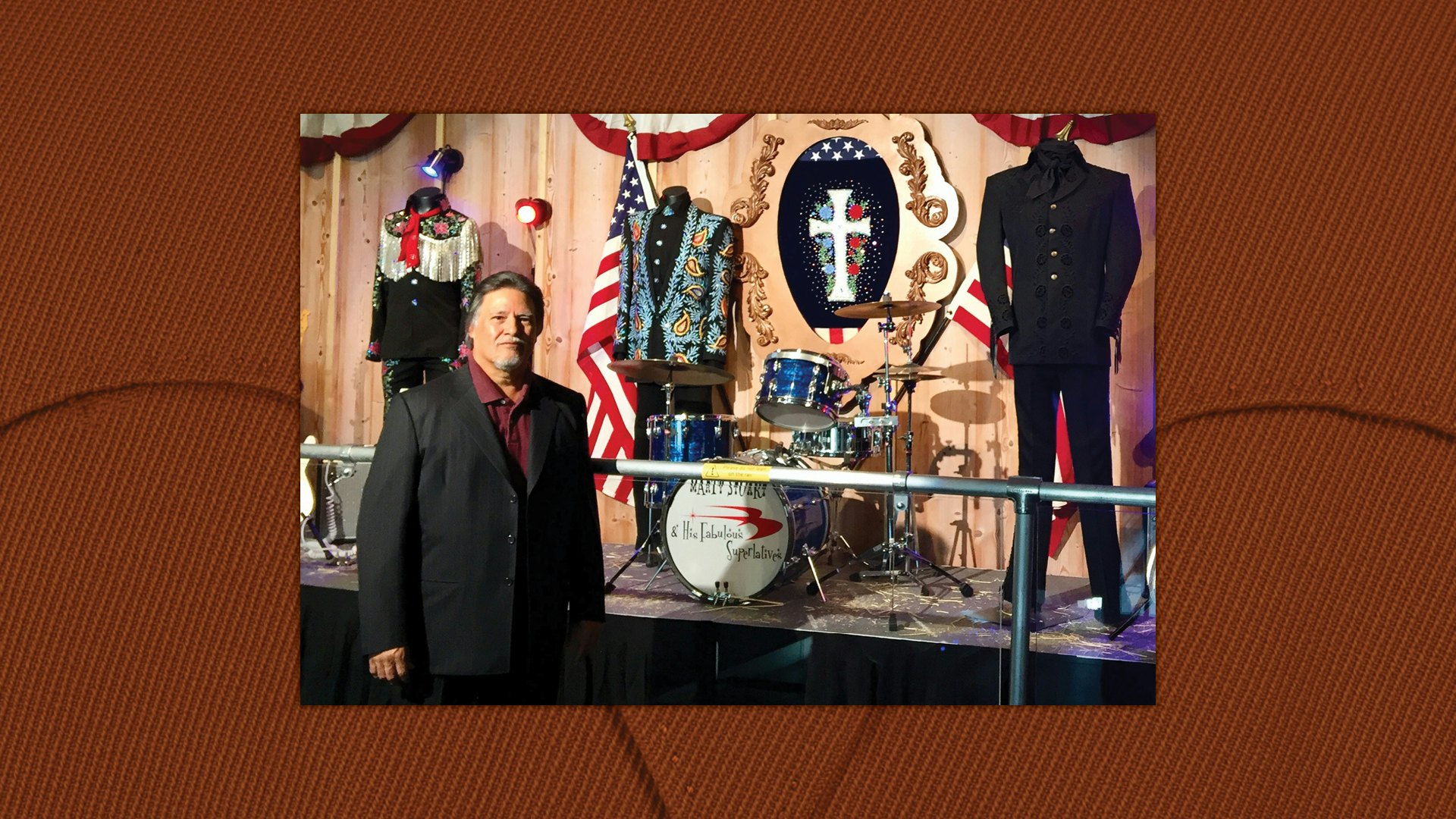
The old Western-tailoring story is often told as a procession of famous names. Jaime Castaneda makes it easier to see the line as a succession of workrooms, people and skills. In a 2017 photograph at the Grammy Museum, he stands among the clothes that helped carry that tradition forward. The Country Music Hall of Fame and Museum calls him a “Western Heir”; its account places him in the shop lineage of Nudie Cohn, Manuel Cuevas and Nathan Turk.1
From Zacatecas to Lankershim
The Hall of Fame says Castaneda was born in 1955, grew up in rural Zacatecas, Mexico, and began his apprenticeship with a local tailor at twelve. It says he arrived in Los Angeles in 1974 and was hired to make pants at Nudie’s Rodeo Tailors. The wording matters because it gives a task inside the shop, not merely a famous association: Castaneda was there as a maker of garments.1
The Autry Museum’s finding aid for the Nudie’s Rodeo Tailors Archives independently names Jaime Castaneda among the workshop’s “shirts and pants” makers, beside Manuel Cuevas, Viola Grae and Rose Clements. A finding aid is not a payroll file or a year-by-year employment record, but it does preserve the role the archive’s description gives him. It is one of the clearest reminders that a celebrated shop depended on cutters, tailors, embroiderers and finishers whose work does not always survive under its own label.2
When Cuevas opened his own North Hollywood shop, the Hall of Fame says he took Castaneda as head tailor. Its Manuel exhibition dates that independent shop to 1975 and names Castaneda among the people who moved into the new operation with master embroiderer Rose Clements and Turk sewing and embroidery machines. The museum’s account records a workshop transition; it does not give us an employment contract, a pay ledger or a complete division of labour.1, 3
A label of his own
The Hall of Fame says Castaneda opened Jaime Custom Tailor and Western Wear and launched his signature label in 1994. That gave the later Los Angeles tailor a shop identity of his own, while keeping the trade’s older vocabulary close at hand: custom fit, collaboration, strong silhouette and decoration made to read from across a room. The museum names Bob Dylan, Buck Owens, Marty Stuart, Johnny Cash and Dwight Yoakam among the musicians for whom it says he designed. Those names belong to the museum’s account, rather than a complete client list or a catalogue of commissions.1
The work can be remarkably direct about its purpose. The Hall of Fame presents Marty Stuart’s black Jaime Custom Tailoring “chandelier shirt” with hundreds of rhinestones, a lace-up front, detachable metallic fringe, and appliqués that include Stuart’s initials, horseshoes and pistols. It is costume built for the eye and for motion: a field of metallic fringe under stage light, but also a precisely organised shirt with its own collar, yoke, cuffs and lacing.1
The workroom is the story
Castaneda’s place in this history is not a footnote after the better-known shops. It is a bridge between them: a documented pants maker at Nudie’s, a named head tailor in the museum’s account of Manuel’s next shop, and later the holder of an independent custom label. That path keeps the field honest. Western wear’s history does not move only through the marquee name; it moves through the people who knew how to cut, fit, stitch and finish a garment until it could carry a singer into the light.1, 2