Ranch clothes enter the fashion pages
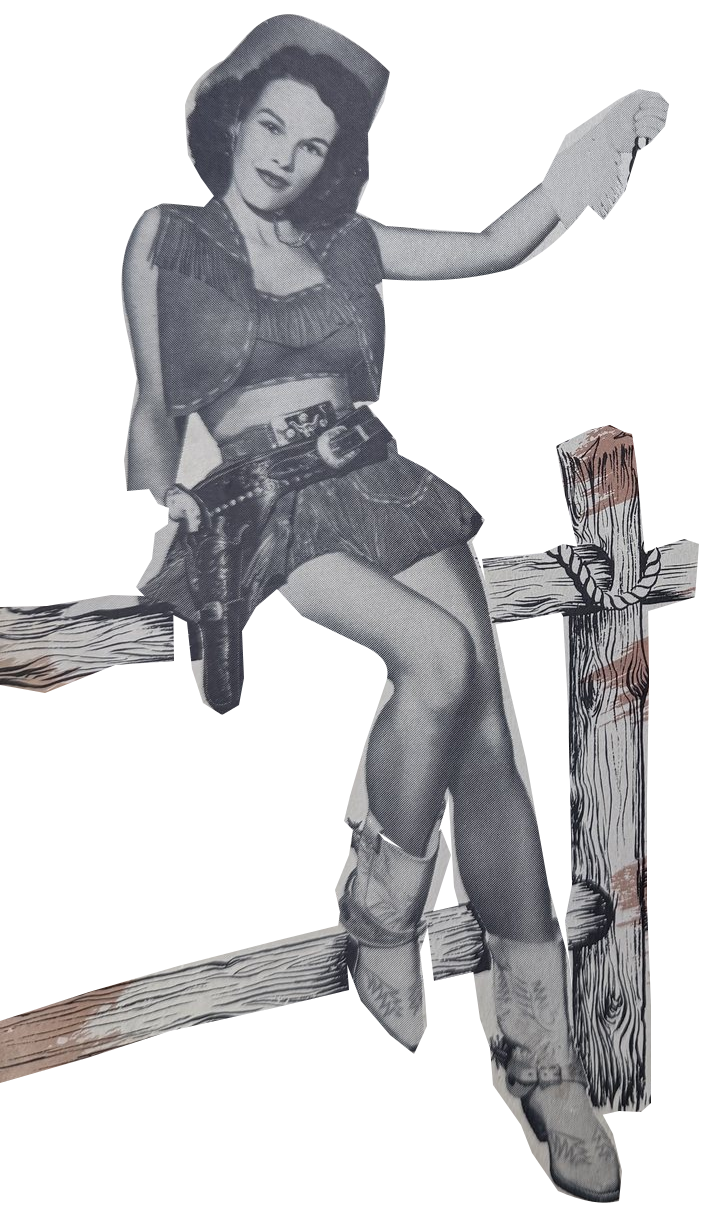
Marge Riley.
Western clothes in the fashion window
Riding clothes become fashion news.
On one page of Life in April 1940, a woman stands against a rail in a black suede divided skirt. White scrollwork and fringe sweep across the hem; the short bolero above it carries the same bright language. Beneath her, another model strides past in close-fitting frontier trousers, their sides laced in white. The magazine printed prices beside both looks. These were Western clothes presented as things a reader could desire, discuss and buy, not as props in a cowboy picture. In the feature's account, the ranch clothes on this page were by Marge Riley. A maker whose work began among Wyoming riders had reached a national fashion magazine. (Source: LIFE-MR-1940)
The choice of a divided skirt mattered. It gave a rider the line of a skirt and room to sit a saddle, while the white appliqué and cut fringe made movement visible from the far side of a photograph. The trousers answered a different wish: a close silhouette, lacing down both outer legs and a matching belt. Life's caption listed the skirt at $35, the bolero at $10.95 and the trousers at $32.50. Those are printed asking prices for the featured looks, not Riley's sales ledger. In each, the Western reference is unmistakable; so is the care taken to make it fashionable. (Source: LIFE-MR-1940)
A rider with a business to build
Riley's early story reaches us chiefly through later institutional writing and one contemporary magazine profile. The Country Music Hall of Fame says she was a Wyoming native who made her own fancy Western clothes in the early 1930s, then began making outfits for neighbouring ranch girls. Life told its readers that she had grown up riding on a Wyoming ranch and had started designing because the clothes she wanted could not be bought. Both accounts present a woman using knowledge of riding dress as the basis for a trade. Neither gives us her first order book, a dated early garment or the names of the women who worked beside her. Their common outline is compelling; the missing workroom record remains worth finding.
The move to Los Angeles enlarged the audience. In 1940 Life reported that Riley had opened a shop there four years earlier. The Hall of Fame gives the same year, 1936. By the magazine's account she also had a Palm Springs branch and supplied Bullock's-Wilshire, I. Magnin and Desmond's. The magazine was describing a maker able to move clothes among ranch customers, city shops and resort visitors. We still need store records or advertisements to learn what each retailer stocked and on what terms. Even within that limit, a nationally printed fashion feature and a named retail network place her far beyond a small local circle.
The 1940 spread is valuable precisely because its credits can be read closely. On page 47, Life identifies the brown suede divided skirt and bolero worn by Jinx Falkenburg on the opposite page as Fashion Sportswear Inc. It then credits the ranch clothes on its own page and the next to Marge Riley. That places the green suede split skirt and bolero photographed with rider Jimmy Rogers, as well as the black suede and blue trouser looks on page 48, within Riley’s printed credit. The distinction gives each business the clothes Life actually placed in its name. (Source: LIFE-MR-1940)
Fashion writing often treats a maker as a name beneath a photograph. Here the clothes tell us more. Riley's page uses a divided skirt, a bolero, tight trousers and a broad belt as separate answers to what a Western woman might want to wear. Riding provides the shapes; colour and surface turn those shapes outward. The magazine packages the result for readers who may have known dude ranches only through pictures. Riley's achievement was to bring her knowledge of that clothing into a market where the wearer could be a rider, a tourist or a performer.
Clothes on a stage
The Country Music Hall of Fame names Gene Autry and Dale Evans among Riley's entertainment customers. Its most particular example is Bonnie Dodd, the steel guitarist who played with Tex Ritter. Beside a drawing of Dodd onstage at San Diego's El Rancho, the museum attributes her outfit, with contrasting fringe and leather appliqué, to Riley. The drawing is captioned about 1946; that dates the museum's presentation of the scene, not an examined garment or a commission document. Still, it makes a useful change of scale. A design language sold as ranch fashion in 1940 could also frame a musician under stage lights. (Source: CMH-FWMR)
This is where collecting stories can outrun the clothes. A 2007 True West caption reported an auction of a shirt it called Roy Rogers's first fringe shirt, attributed it to Riley and gave it a 1947 date. Auction records also describe garments associated with Dale Evans and bearing or said to bear a Riley label. They are strong leads for finding labelled objects and custody records; their printed descriptions are not yet a substitute for those records. The Hall of Fame's named-performer account gives us the broad entertainment connection. A future garment gallery can grow from the specific objects once their labels, histories and image permissions are examined one by one.
Riley's stage clothes belong in the same history as Nudie's and Turk's, but they should not be forced into the same tale. Her 1940 fashion page shows a Western maker already thinking about how women would move between riding and public display. Dodd's outfit takes fringe and appliqué into music; the department-store names take the clothes into retail. There is no need to pretend that one photograph proves the whole route. The distinct records show how many routes Riley's name could travel.
A shop a customer could find
The Palm Springs story has a second life in ordinary records. In the 1964 city directory, “Marge Riley Western Riding Clothes” appears at 227 South Palm Canyon Drive. The entry names Marge Carr, while a Carr household listing refers to “Marge Riley Western Shop.” Those pages establish the listed business and an associated person; they do not tell us whether Riley and Carr were the same woman, partners or successive proprietors. The distinction matters whenever a shop name is used as shorthand for the person who cut and sewed each garment. (Source: PS-1964)
A 1966 telephone directory prints “Riley Marge Westerns” at the same street address and gives a telephone number, 325-6887. That is a particularly human scrap of history: an address and number a customer could use, not an after-the-fact legend. It places the name in the local trade after the national magazine moment. A directory cannot tell us whether the person at the counter was Riley, Carr or someone else, or what was made on the premises. It does show that the business identity remained visible in Palm Springs. (Source: PS-1966)
Three colour slides, now presented by Deserted Films as Palm Springs in April 1964, offer the shop's most arresting surviving view in this dossier. On the facade, red letters spell “MARGE RILEY,” with “WESTERNS” below and “227” over the window. There is a wagon wheel above the sign, a carousel horse in front and Western outfits in the display. The mountains rise behind the tiled roof. The host's date and place identification still need the original slide provenance, but the lettering itself is there to read. Together with the directories, the images make the business tangible as a place people could enter.
There is a tempting story in an online reproduction of a 1954 letter attributed to Riley, offering President Eisenhower a Western suit and hat from the Palm Canyon shop. The official appointment book does put Eisenhower in Palm Springs on the letter's date. It does not mention Riley, a suit or any correspondence. The reproduced page has no established archival origin, so it cannot yet be made into an episode in her life. The proper presidential-paper folder is a research route, not a completed source. Until it yields the original, the 1964–66 directories and the shop sign do more honest work for the Palm Springs chapter.
What her name came to mean
Marge Riley left several kinds of trace: a national magazine's credited outfits, the Hall of Fame's account of a working rider turned maker, its attribution of Bonnie Dodd's costume, retail names, directory listings and a shop sign in a colour slide. Each shows a different scale of her work. The magazine catches design at the point of sale; the stage drawing catches its public effect; the directory and window show the continuing business of getting a garment to a customer.
The people around those clothes deserve more than a famous-client roll call. Who made the store stock, who handled alterations, who drew a pattern for a rider, and how did the Palm Springs shop change after 1940? Those answers are not in the present source set. The next labelled garment and the next store record may give them. What we can already see is Riley's place in the making of a modern Western wardrobe: she carried the practical memory of riding dress into fashion, retail and performance, and gave women more than one way to wear the West.
A storefront with a record
A Palm Springs Historical Society catalogue record identifies “Image, Digital — 65-011” as the Marge Riley Westerns store in the Village Green and credits photographer Noel W. Frederick II in the Frederick-Brodeur Collection. The public catalogue does not provide a secure date, so it cannot tighten the date of the nearby slides or identify the clothes in the windows. It does give the storefront an institutional record alongside the directories and visible sign.
Sources & further reading
- *Life*, 22 April 1940, vol. 8, no. 17
- CMHOF, “Western Style Roundup”
- Meghan Saar, “Collecting the West,” *True West*, September 2007, printed p. 18 / PDF p. 20
- Heritage Auctions, Dale Evans Cropped Sleeveless Bolero Jacket, auction 7318 lot 89084
- Roy Rogers & Dale Evans Museum Auction, Burley Auction Group / iCollector, lot 90
- Augusta Auctions, October 2008 lot 911, *Marge Riley Cowgirl Outfit*
- Palm Springs city directory, 1964
- Palm Springs telephone directory, 1966
- Deserted Films, “Palm Springs Ephemera”
- Blue Book Files, “Eisenhower Edward-s AFB 4”
- Eisenhower Presidential Library, *The President’s Appointments*, February 1954