California · Custom tailoring
Nathan Turk.
The work behind the spectacle
The colour. The cut. The work.
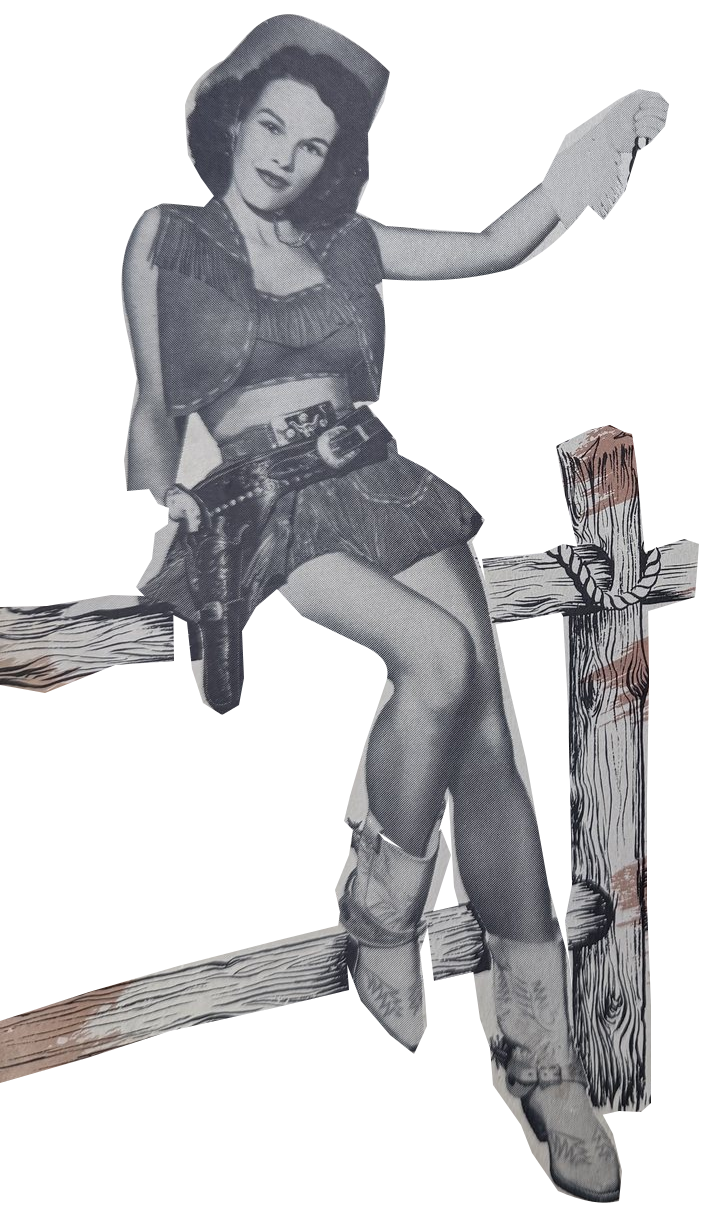
In a photograph of the Maddox Brothers & Rose, five performers stand together in coordinated Western stage clothes: Cal, Henry, Rose, Don and Fred. You can see the family resemblance in their faces; the clothes give them another resemblance, an act designed to be recognised from the back row. The surviving museum ensembles tell a further story. Rose’s shirt, bolero and split skirt were made for her; each brother’s suit had its own decoration. Rose later explained that the brothers could shed their jackets in summer heat and still look like the same band. The photograph and the surviving garments belong to the same stage history, though this image alone does not identify which pictured clothes survive.
That was Nathan Turk’s gift: he could make a whole performance visible before the first note. His name now sits on labels inside shirts, but the work was never only his. It came from a boy’s apprenticeship in Eastern Europe, from the trade he and his wife Bessie built on a Los Angeles boulevard, from the hands that cut and finished each garment, and from the musicians who knew what a suit had to do once it left the hanger. Follow the seams and a history of immigration, California commerce, country music and show business comes into view.
A tailor before there was a West to dress
He was born Nathan Teig in 1895 to Yoyna and Pearl, in a village near Minsk in what is now Belarus. At ten, his father sent him to a tailor in Warsaw to learn the trade. Those two places should not be collapsed into one convenient origin. The village was where he began; Warsaw was where he learned to sew. He came to America in his teens. We have the broad path, though not every intermediate stop or the precise moment Teig became Turk.
The boy was trained to make clothes fit bodies and last under use. Years later the surfaces would be extravagant, but Turk’s best work would still depend on what he learned in that apprenticeship: shape, cloth, a sound seam, a finished edge. It is tempting to tell an immigrant’s life as a straight line from hardship to success. This one takes a bend through a dry-cleaning and alterations shop. In the early 1920s Turk moved to Los Angeles and opened a business on Ventura Boulevard, near movie production and the ranches that served Hollywood’s Westerns. Alterations paid for the day while a new market came through the door.
He watched Western films and began making clothes for the screen cowboys who visited. The West he entered was already part history, part working ranch, part parade and part camera trick. Turk did not invent it from nothing. What an immigrant tailor could do was improve the costume until the fiction held up under a studio light, in a street parade and on the body of a man expected to be a hero every time the camera found him.
Ventura Boulevard
The shop’s story is anchored by addresses, not just reminiscence. A Van Nuys directory for 1945–46 lists “Turk Nathan” under tailors at 13711 Ventura Boulevard. A 1949 newspaper notice reports a proposed Turk store and dwelling at 13715 Ventura Boulevard. A surviving label in a Chicago museum shirt carries that latter number. The numbers differ because the records belong to different moments; a street number on a label can help tell a garment’s story, but it is not a date stamp by itself.
At first the work was local: cleaning, fitting, altering. By the 1930s Turk had made equestrian and Western outfits for riders in Pasadena’s Rose parades. The Chicago History Museum places Gene Autry among the film clients who then came to him, with Roy Rogers another major customer. These were not anonymous extras. Autry and Rogers were making the cowboy a repeatable public image across film, radio, appearances and merchandise. A suit could not only look convincing in a close-up; it had to be recognisable wherever its wearer showed up next.
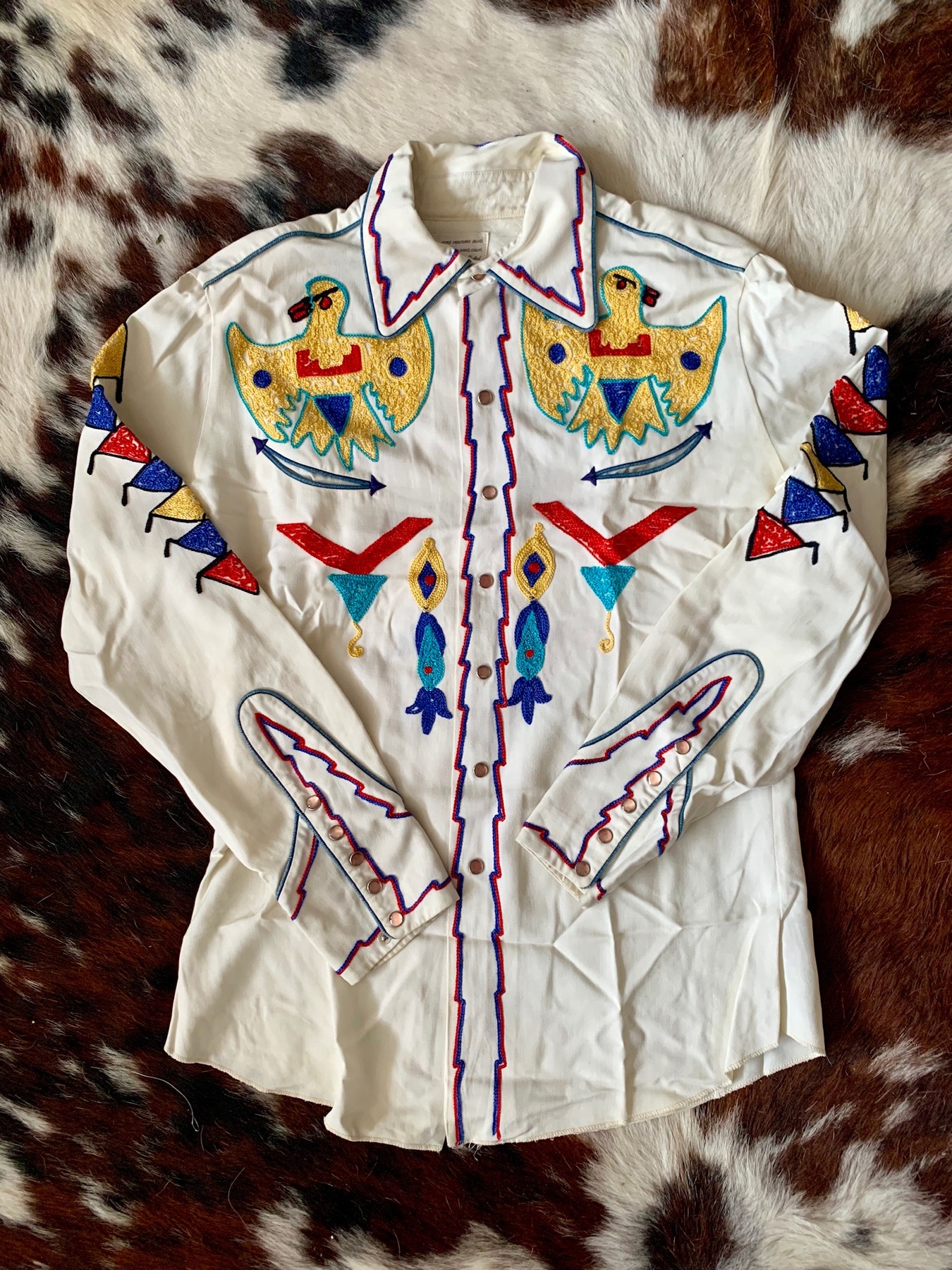
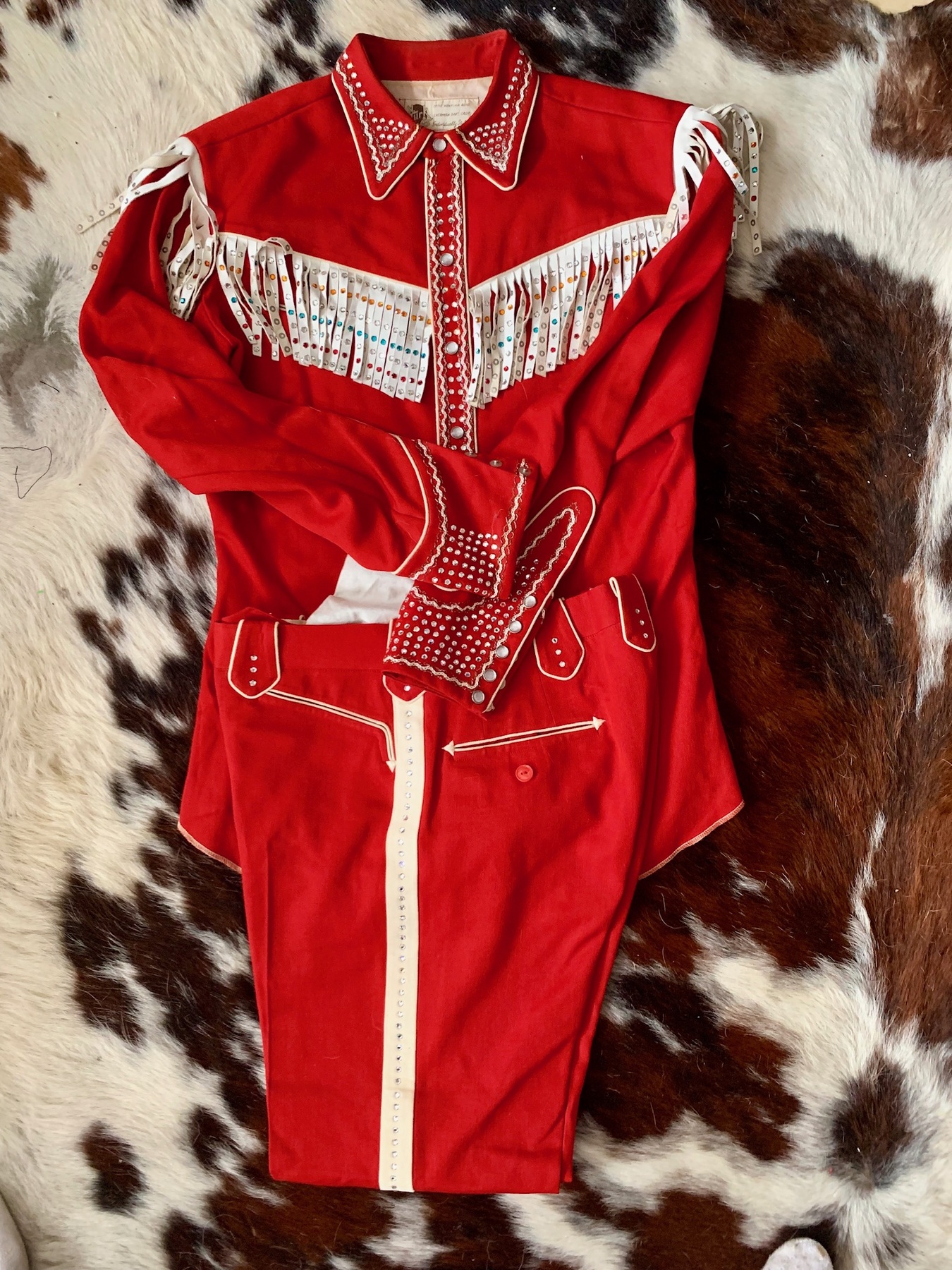
The shop sold ready-made clothes as well as individually designed garments. That range matters. The phrase English Western Apparel appears on several Turk labels, sometimes joined by Individually Styled. Inside the shirt is both maker’s mark and pitch: craftsmanship offered to a buyer who might not be a movie star. On a Philip K. Wrigley shirt, the label names the Ventura Boulevard address. In an auction photograph of a purple bolero it names Sherman Oaks. Collectors can use those labels as clues, though they cannot safely make a full chronology out of three surviving examples.
Business records also show Turk in country music’s working network. In a 1954 Billboard page thanking the people who helped the Abbott and Fabor labels, N. Turk is named as tailor to their stars, with the 13715 Ventura Boulevard address. It is a modest line on a crowded trade page, and all the better for that. A tailor was part of the machinery around a record: the pressing plant, photographer, publicist and clothes maker each helped turn a performance into a public career.
Bessie’s hand
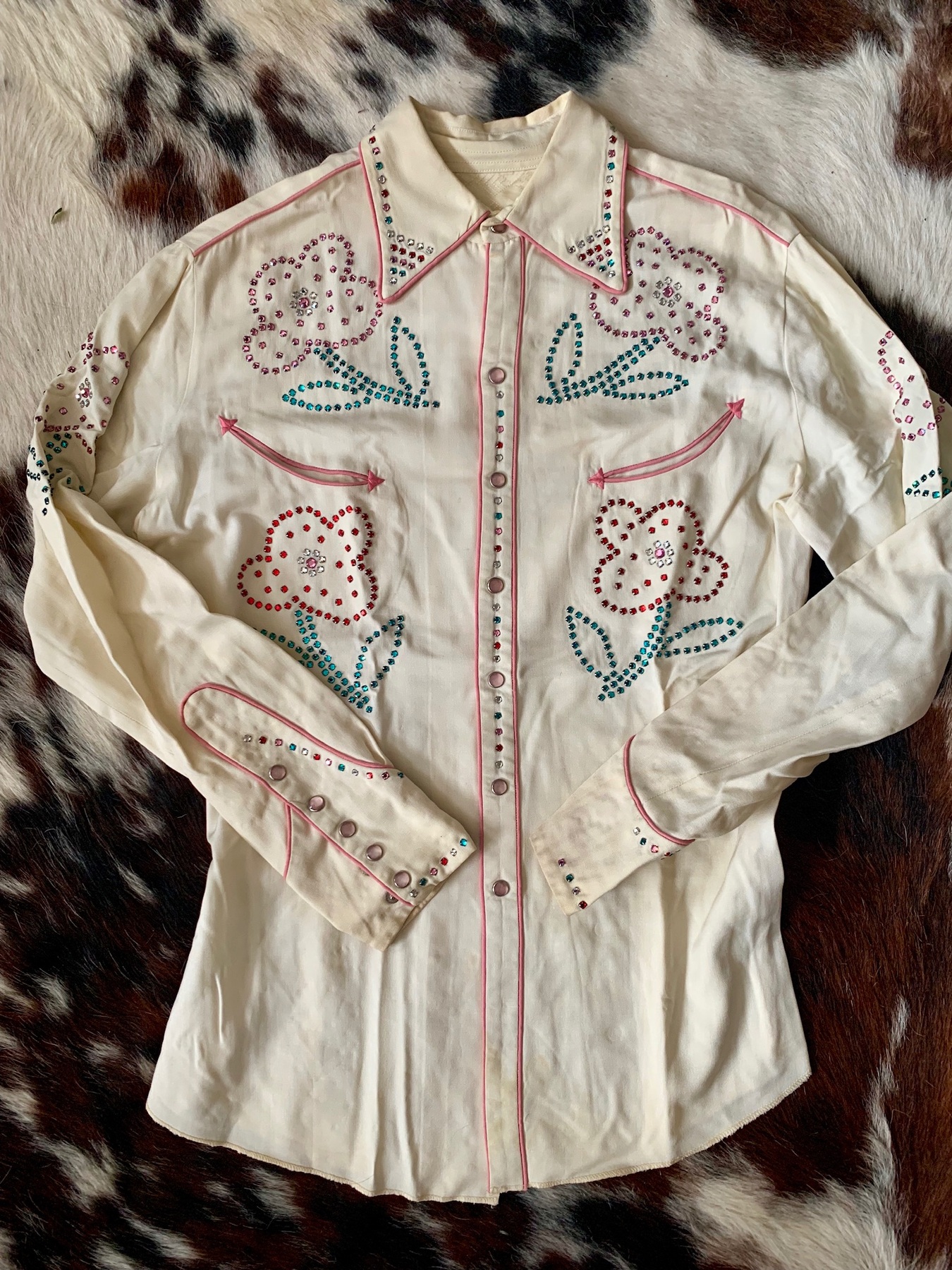
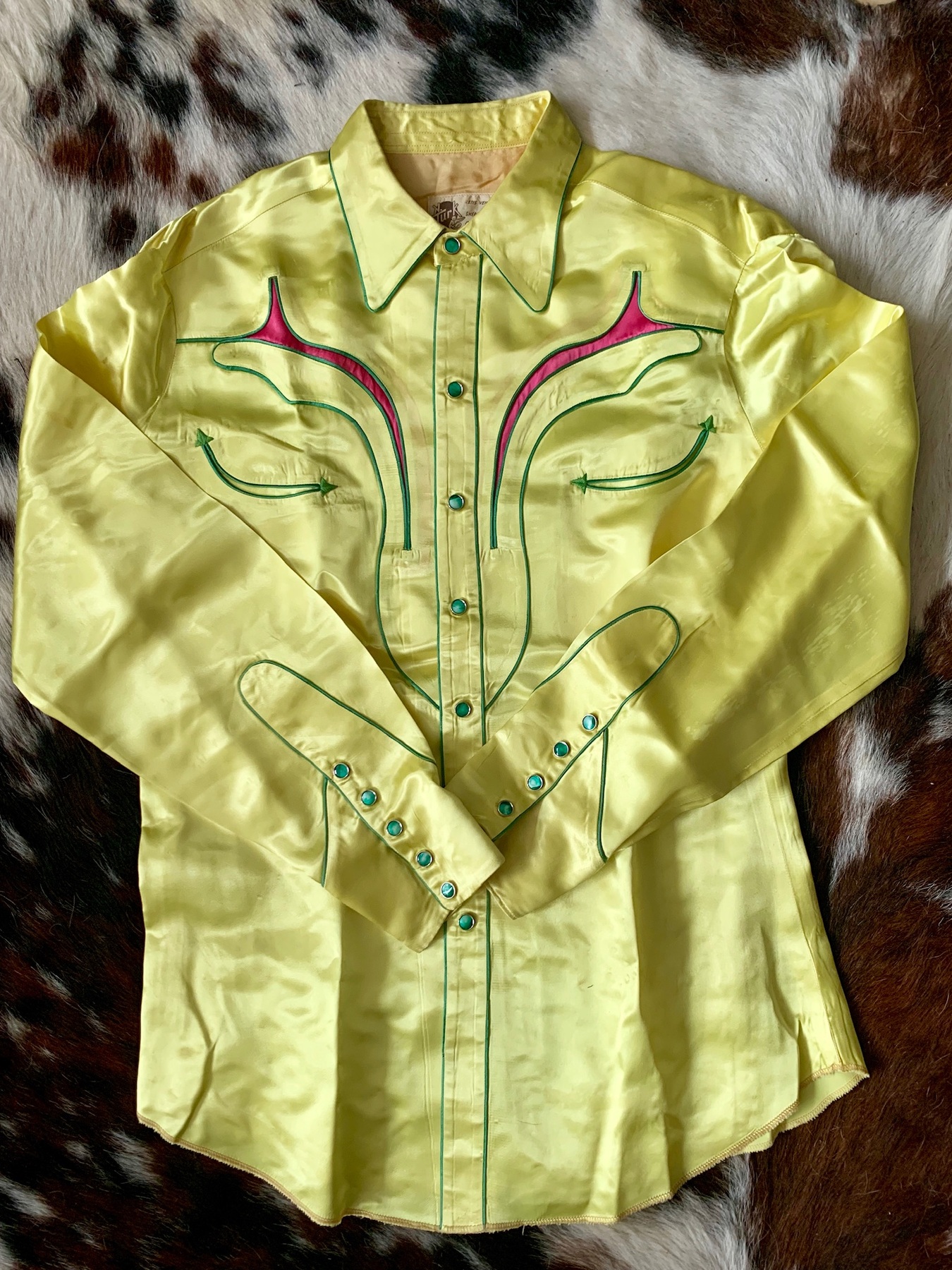
The name sewn into a garment tells you whose shop sold it. It does not tell you every person who made it. Turk’s business was a family enterprise, and Bessie Turk’s skill appears in details that often survive better than anyone’s account of the workday. The museum identifies her hand-sewn arrowheads reinforcing pocket and seam ends as a specialty of the shop. Their practical purpose was to strengthen points under strain. Their visible result was a crisp, deliberate finish at the edge of a flourish.
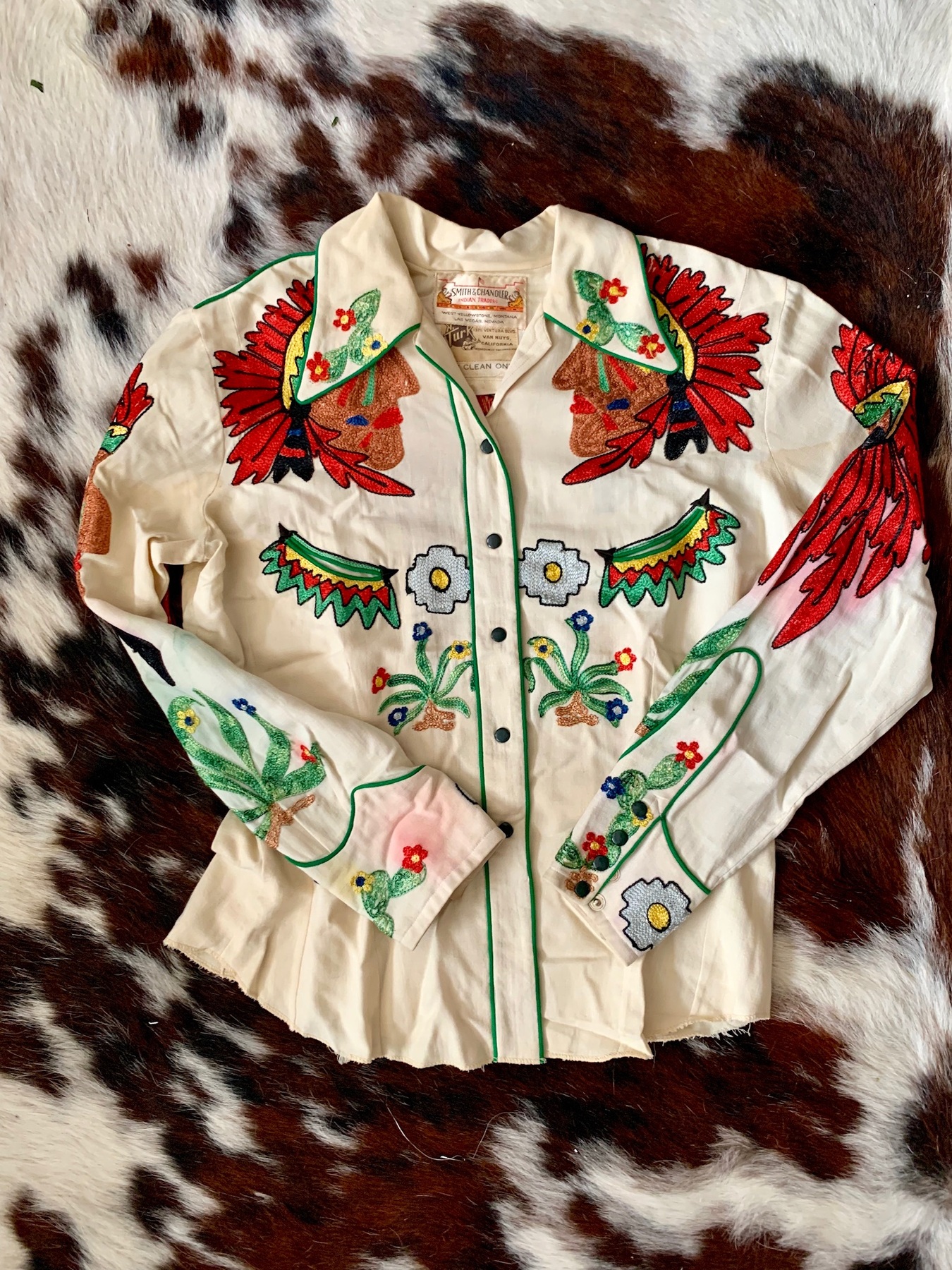
Consider the wool-gabardine shirt Turk made for Freddie “Careless” Love, a singer with Spade Cooley’s western-swing band. Hearts and messenger doves travel across it. Piping marks the lines of the body; enamel snaps and shotgun cuffs finish the front and sleeves. At the pockets, those stitched arrowheads hold decoration and utility in the same few inches of cloth. The museum specifically credits Bessie’s finishing. To praise the design while losing her hand would be to read only half the garment.
We know Bessie’s role in these identified pieces; we do not have a complete personnel ledger for every shirt to leave the shop. That limit makes the named work more valuable. It lets us see a marriage and business partnership in the technical decisions of a garment, rather than reducing Bessie to a line about a wife who helped.
Five people, one band
The Maddox family brought their own history into Turk’s shop. They had travelled from Alabama to California and worked as migrant farm labourers before building a musical act out of country songs, comedy, western swing and an extraordinary willingness to be seen. A band dressed this boldly might invite the lazy word costume as if that settled the matter. But their clothes were working tools. Across a stage, repeated colour and shape made the family unmistakable. Close up, each garment had to suit the particular musician wearing it.
Rose’s three-piece outfit joins satin shirt, bolero and divided skirt. Red enamel snaps, flowers, vines, chain-stitched roses, suede fringe and piping give it density without turning it into one flat patch of ornament. The divided skirt made sense for a cowgirl performer who needed to move. The brothers wore related but distinct suits: Cal’s short jacket and bell-bottom trousers, Fred’s grape embroidery, Don’s smile pockets and arrowhead stitching, Henry’s floral work. Turk could repeat a visual idea and still let each player have a part.
The museum connects some of the chain-stitched motifs on the brothers’ clothes to Slavic folk-art forms. That is a meaningful reading of the surviving pieces, though a particular flower should not be assigned a specific Old World hometown on appearance alone. The real exchange is more interesting: techniques learned in an immigrant tailoring life were put to work for a band of California migrants making new American music. Rose later explained that the shirts matched the trousers so the brothers could shed their jackets in summer heat and keep the look. Stagecraft lives in that practical sentence.
The image set gives a page designer an opportunity once the figure identities are secure: show the group first, then move between identified garments at near life size. A gallery of all five outfits would turn “matching costumes” from an abstract claim into something one can compare. For now, the archive has a confirmed group photograph and Cal suit views, while Rose’s correctly matched ensemble image still needs recovery.
Let the performer bring the joke
Turk’s customer was sometimes a collaborator in the most literal sense. Les “Carrot Top” Anderson recalled drawing a little carrot figure through the night after acquiring his nickname, then taking the sketch to Turk. The resulting costume included a detachable bib with a boot-wearing, pistol-carrying carrot man, worked in embroidery and rhinestones. A nickname became a drawing; the workshop gave it enough scale and clarity to travel across a dance hall.
That is a good answer to the idea that a star merely commissioned glamour. Anderson had the joke. Turk knew how to make it wearable. The singer kept ownership of his persona while the tailor solved the visual problem. A costume could be funny, but it was never casual work. Someone had to choose the cloth, hold the bib in place, set the snaps and make the drawing legible once the band started moving.
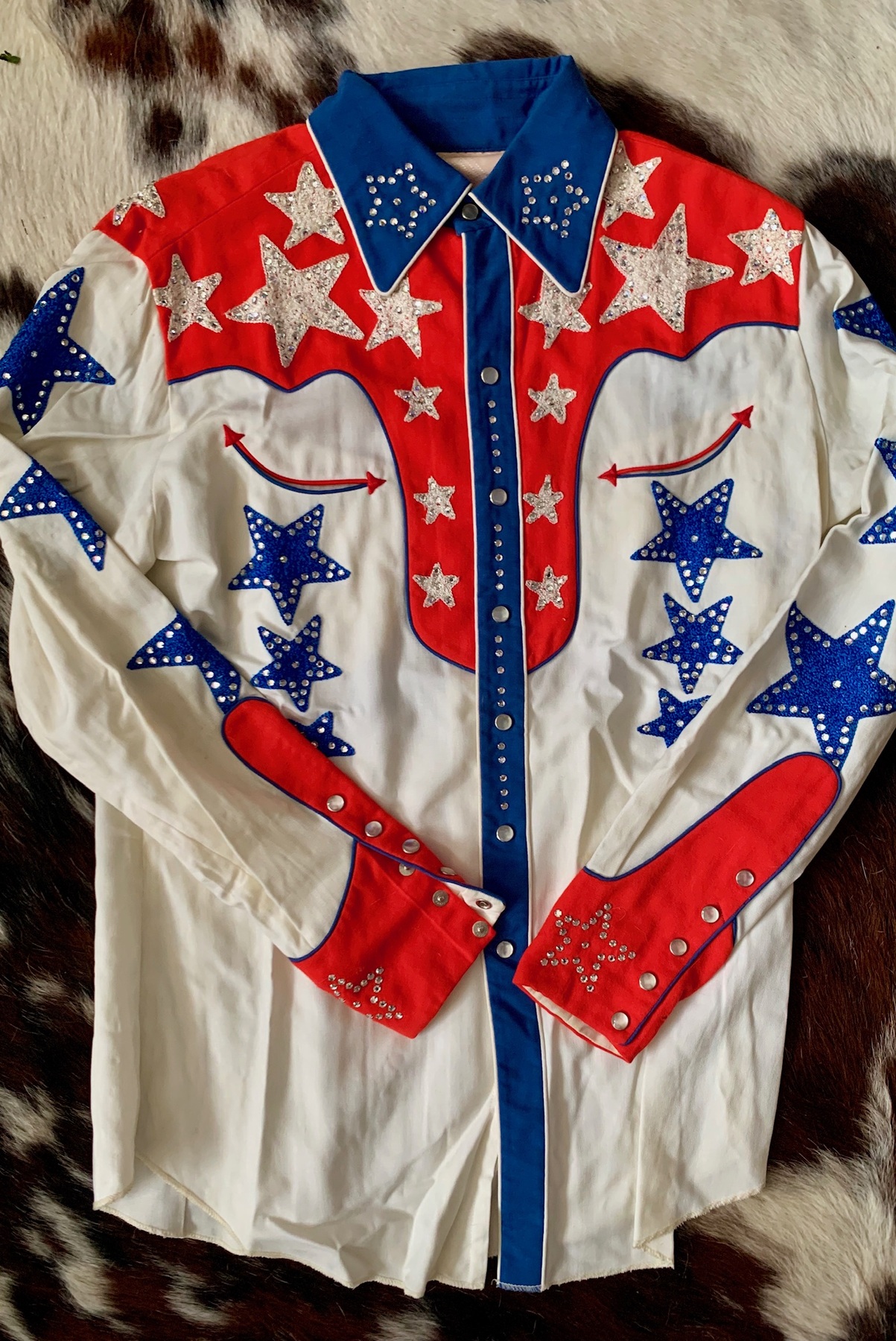
Other garments speak in a different register. Johnny Horton’s shirt carries horse heads; Tex Ritter’s two-tone shirt relies on colour, piping and clean smile pockets. The common vocabulary is Turk’s, but the subject changes with the performer. That is why the surviving shirts matter beyond celebrity association: they show how a shop made an individual public image from cut and surface.
A shirt fit for a company owner
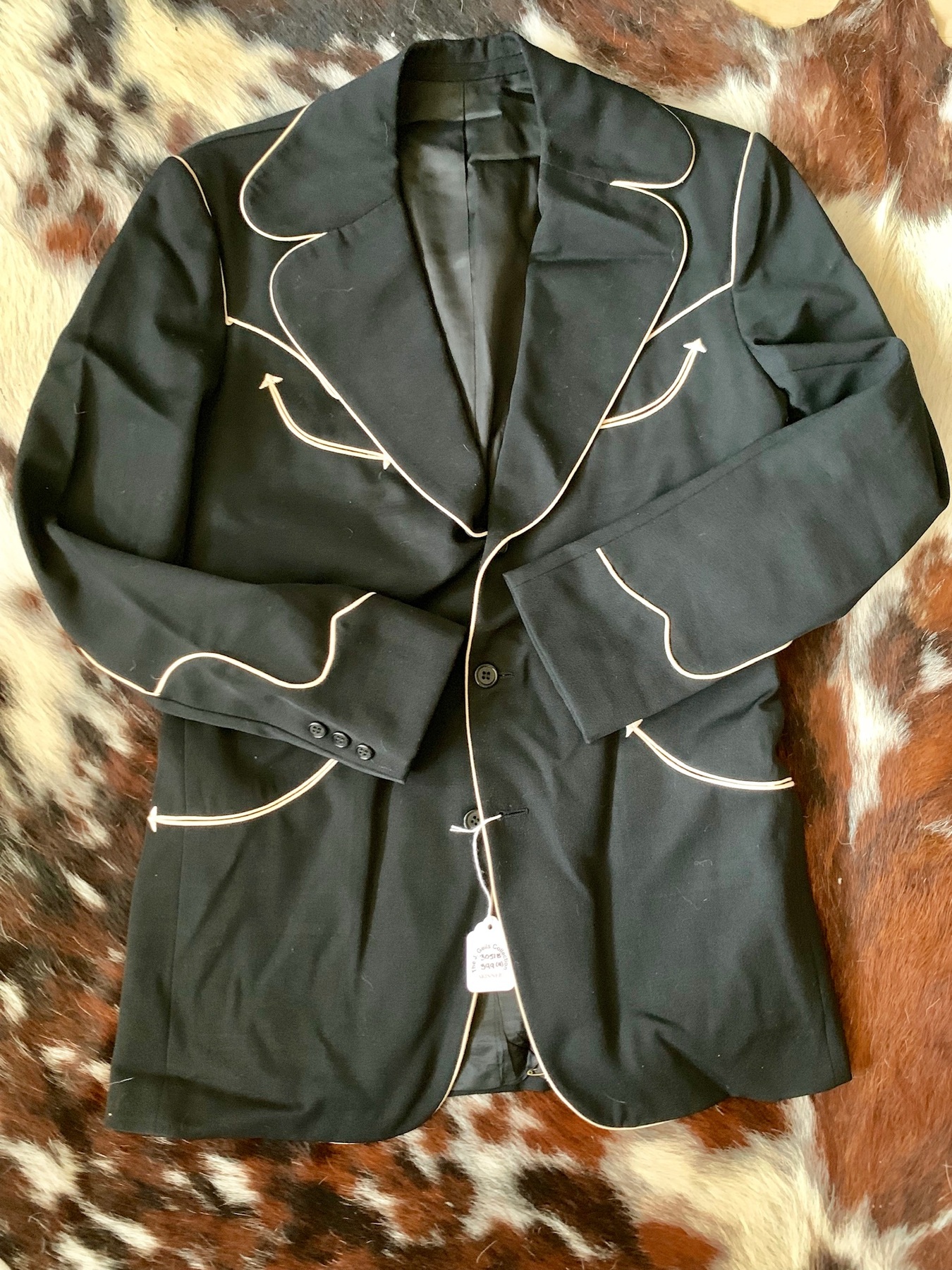
One of the most revealing Turk garments was worn not by a singer, but by Philip K. Wrigley. Chicago History Museum holds his peach-coloured shirt, dated to around 1960 and donated by Wrigley’s son. Light brown yokes and cuffs interrupt the body; brown piping follows the construction lines; two smile pockets curve across the chest. The museum notes finished seams, a quilted collar stand, satin-lined pockets and yokes, and hand finishing. Those details are hard to see in a full-stage photograph. On the object they are evidence of how seriously the shop took a shirt’s inside.
Wrigley could afford fine tailoring and chose this kind of Western shirt. The shop’s market had widened beyond rodeo riders and musicians to people who wanted some of their confidence and visual ease. Turk could supply that without making every buyer look as if he were about to enter a picture show. The Wrigley shirt is comparatively restrained, and precisely made. Its quietness is part of the range.
The band in blue
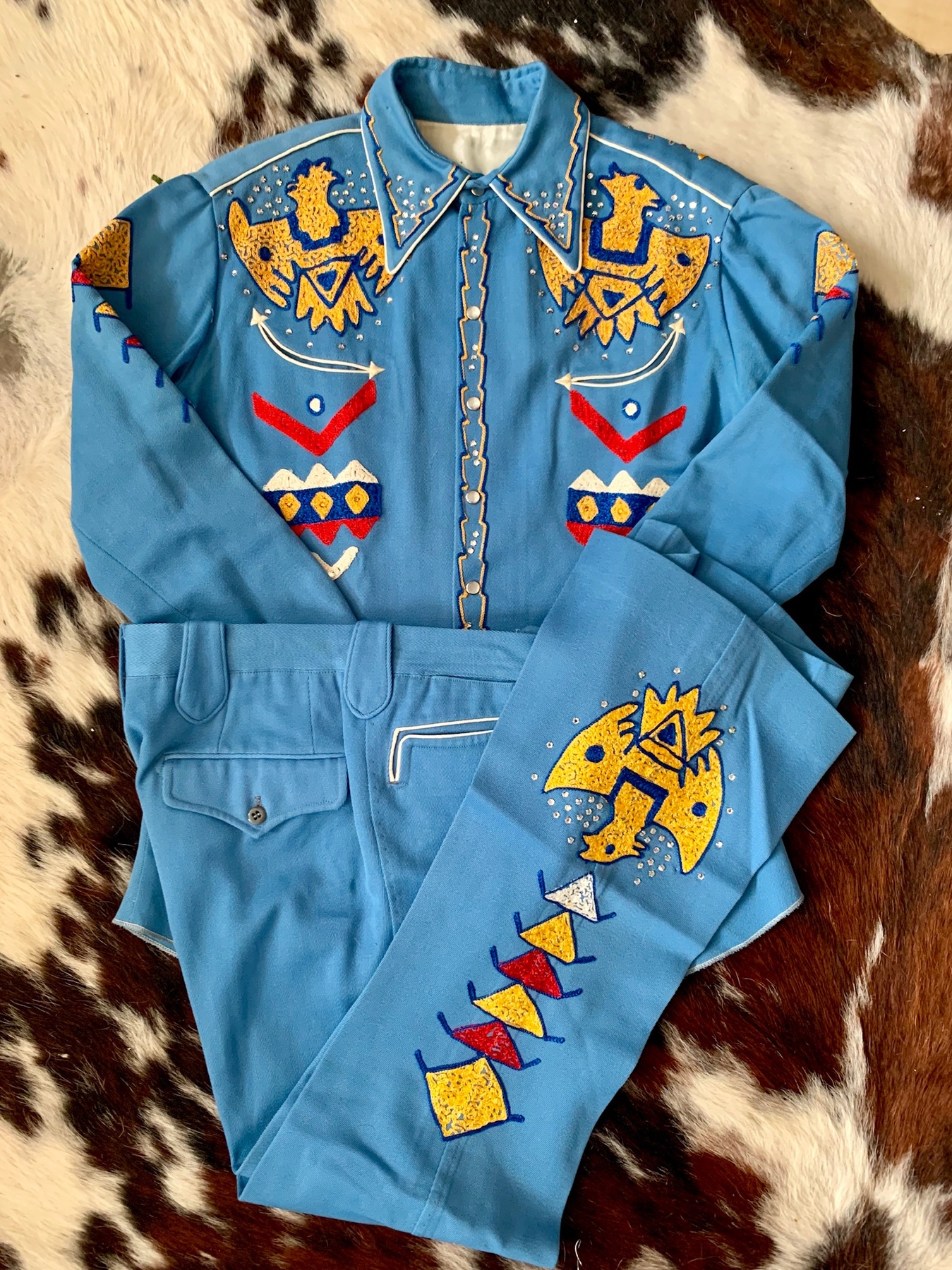
In March 1966 Buck Owens and his Buckaroos arrived at Carnegie Hall with a question larger than the evening’s set list: how would a New York audience receive a country band from Bakersfield? On the album-cover photograph, Owens stands in yellow and the band in matching blue. The suits are Turk’s. One colour gives Buck the lead; another makes the Buckaroos read as a unit. That is the same problem Turk solved for the Maddox family, now carried to a very different room and to a record sleeve that would be seen long after the performance.
Don Rich’s surviving blue suit shows how the image was made. Insets, rhinestones, piping, smile pockets and stitched arrowheads share the work. From the sidewalk outside Carnegie Hall, the group read immediately as an act. On the museum garment, those choices become tangible again, one seam and one bright line at a time.
The concert album crossed from country charts to a wider audience. Its cover carried Turk’s contribution with it. A tailor could not play the show or make the record, but the clothes helped the musicians assert that they belonged there, as themselves, on one of America’s most formal stages.
The trade keeps moving
Turk’s 1964 trade advertisement offered embroidery, fringe, rhinestones, stage and television clothes, and group orders. It is a compact description of the business he had built: bespoke invention supported by the systems to outfit an entire act. In the same decade that the Buckaroos wore Turk to Carnegie Hall, the shop still had to sell, cut, fit and deliver. Great show clothes are also small-business logistics.
The shop belongs in a network rather than a solitary genius story. The National Endowment for the Arts records that Manuel Cuevas, a young Mexican immigrant who had learned to sew as a child, worked with Turk in Hollywood before becoming Nudie Cohn’s lead tailor and eventually opening his own store. The Rose Parade clothes made a particular impression on Manuel. Knowledge moved among workshops, teachers and customers. Turk’s apprenticeship in Warsaw had become part of a California trade that would teach another generation.
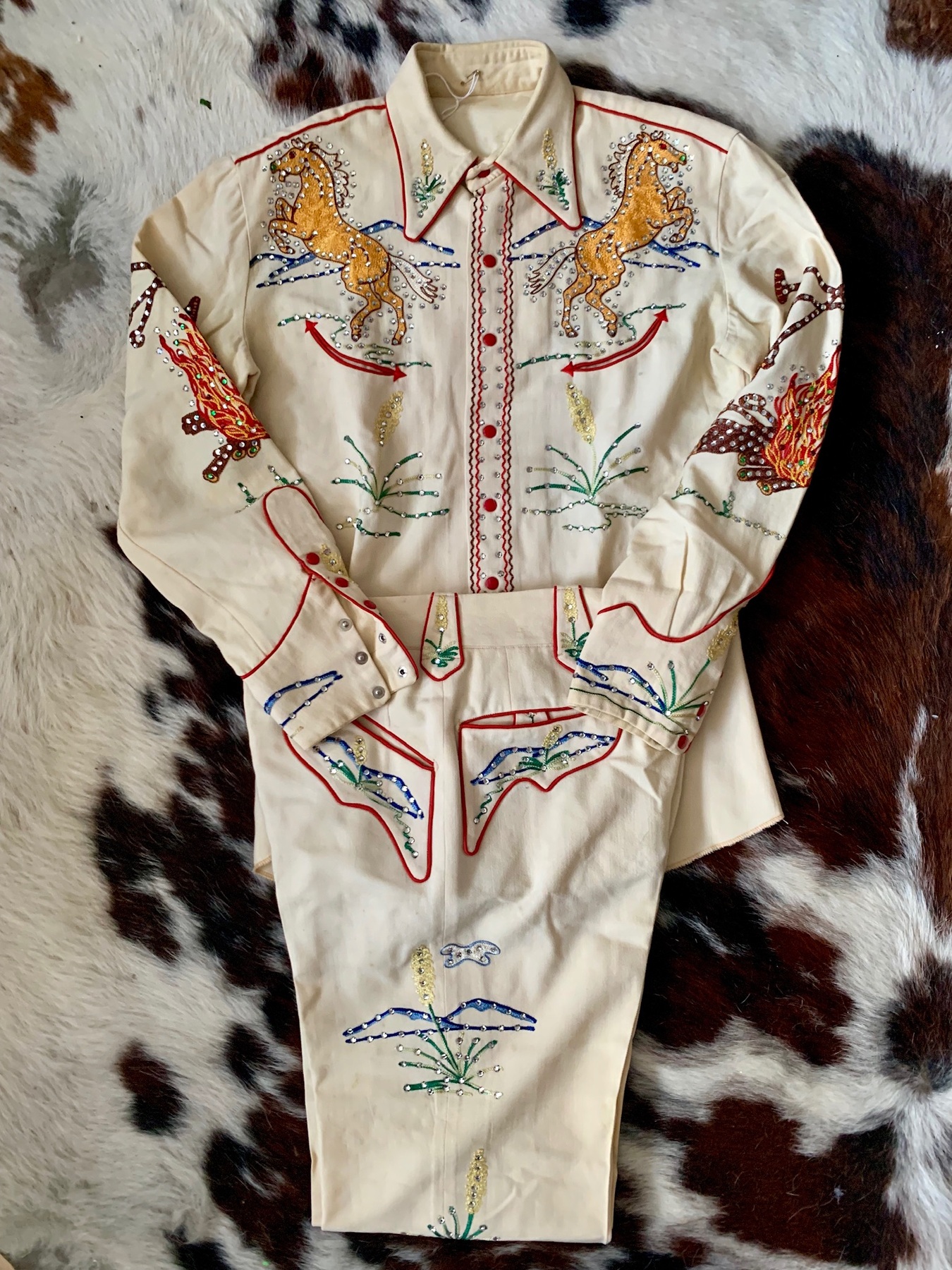
The archive becomes less continuous in Turk’s later years. A TCU costume collection holds a horned-frog Western shirt and matching trousers attributed to his shop and dated broadly to the late 1970s or early 1980s, but the original wearer is unknown. Accounts of the shop’s closure and transfer of equipment to Manuel vary, and the available primary records do not yet settle the sequence. Better to let the object stand for what it can prove: Turk’s label and workmanship continued to circulate well beyond the heyday of the singing cowboy.
What remains in the seams
Nathan Turk’s biography cannot be told only through the famous names on his customer list. Gene Autry and Roy Rogers helped make his shop visible; the Maddox family turned his clothes into a band’s fierce visual signature; Buck Owens took them to Carnegie Hall. Yet the evidence is richest when a camera moves closer. Bessie’s reinforcing stitches, the division in Rose’s skirt, the lining inside a Wrigley pocket, the still-readable address on a label: each one tells us how spectacle was built and made durable.
He began as Nathan Teig, a boy sent to learn a trade far from the American West. In California, that skill met film, rodeo, migrant music and the appetites of a growing entertainment business. The result was neither an old European garment dressed up as a cowboy nor a ranch shirt with glitter stuck on. It was a new language made by people whose journeys did not resemble the frontier myths they helped put on stage. Turk’s work is still powerful because it could make an act look larger than life while surviving, at close range, the unforgiving test of a tailor’s eye.
The name in circulation
A Southern Oregon Saddle Co. advertisement of 7 August 1946 offered a ladies’ two-piece suit made by “that famous Hollywood tailor, ‘Turk.’” It shows a Turk-identified women’s garment in a retailer’s stock far from Los Angeles, without pretending to identify the buyer or describe the suit beyond that printed line.
An undated Country Music Hall of Fame backstage-interview index makes a different distinction: Biff Collie referred to Buck Owens’s gold “Nudie” suit, then named Nathan Turk as its maker. The index does not identify the particular garment or preserve Owens’s answer. It does catch a contemporary speaker separating a familiar generic label from the tailor he meant.
Sources & further reading
- CMHOF, “Nathan Turk: Old World Meets New West”
- Chicago History Museum, “A CHM Western Wear Treasure”
- Los Angeles Public Library, *Van Nuys City Directory 1945–1946*
- *Van Nuys News*, 26 May 1949, p. 3 (displayed NewspaperArchive route)
- Augusta Auctions, October 2008 past-sale listings, lots 694, 696, 697 and 700
- *Billboard*, 20 February 1954
- Library of Congress, “Carnegie Hall Concert with Buck Owens and His Buckaroos” essay
- *Billboard*, 14 November 1964, *The World of Country Music*
- National Endowment for the Arts, Manuel Cuevas
- TCU Magazine, “Object lesson: Tailor made”