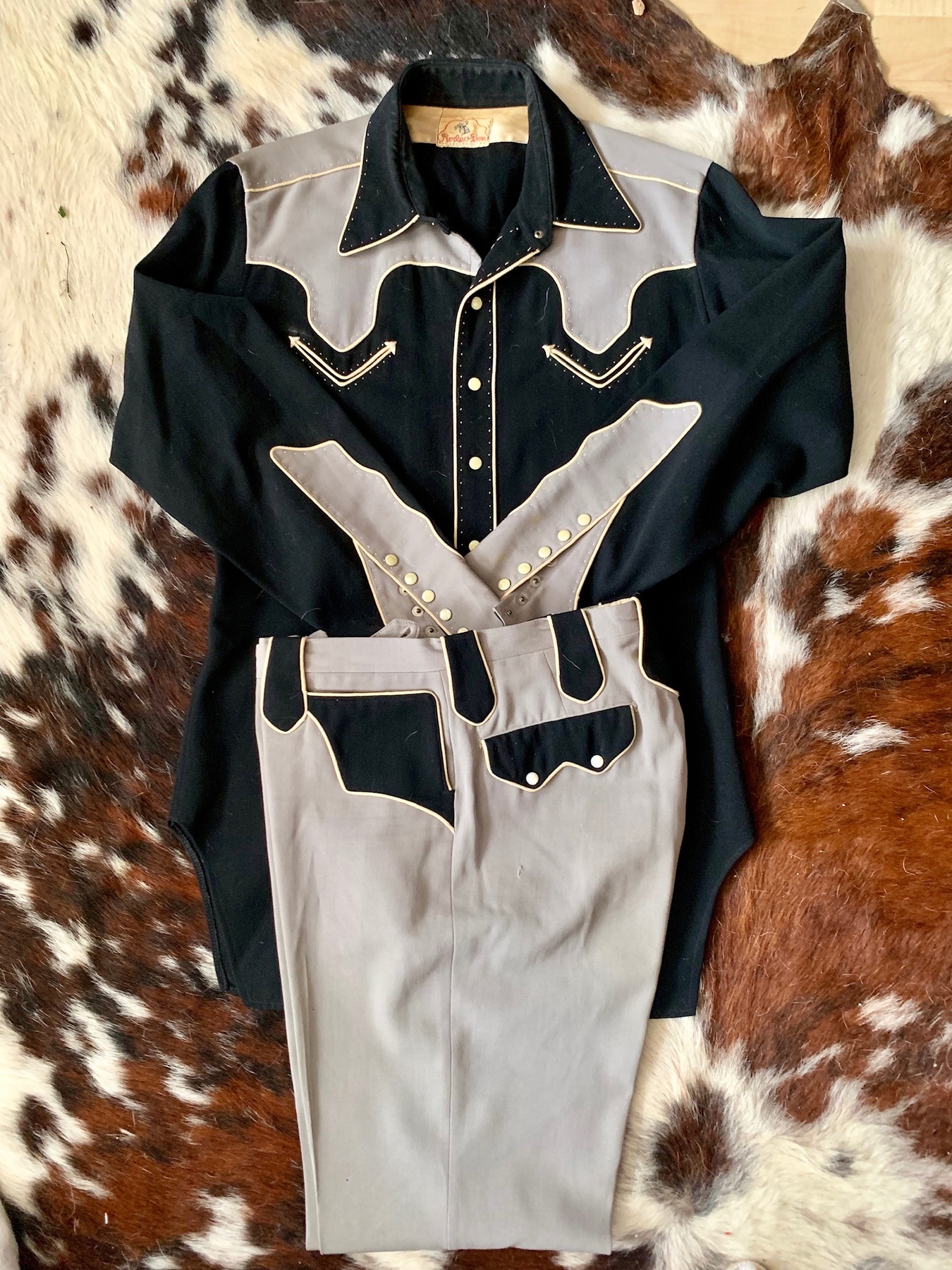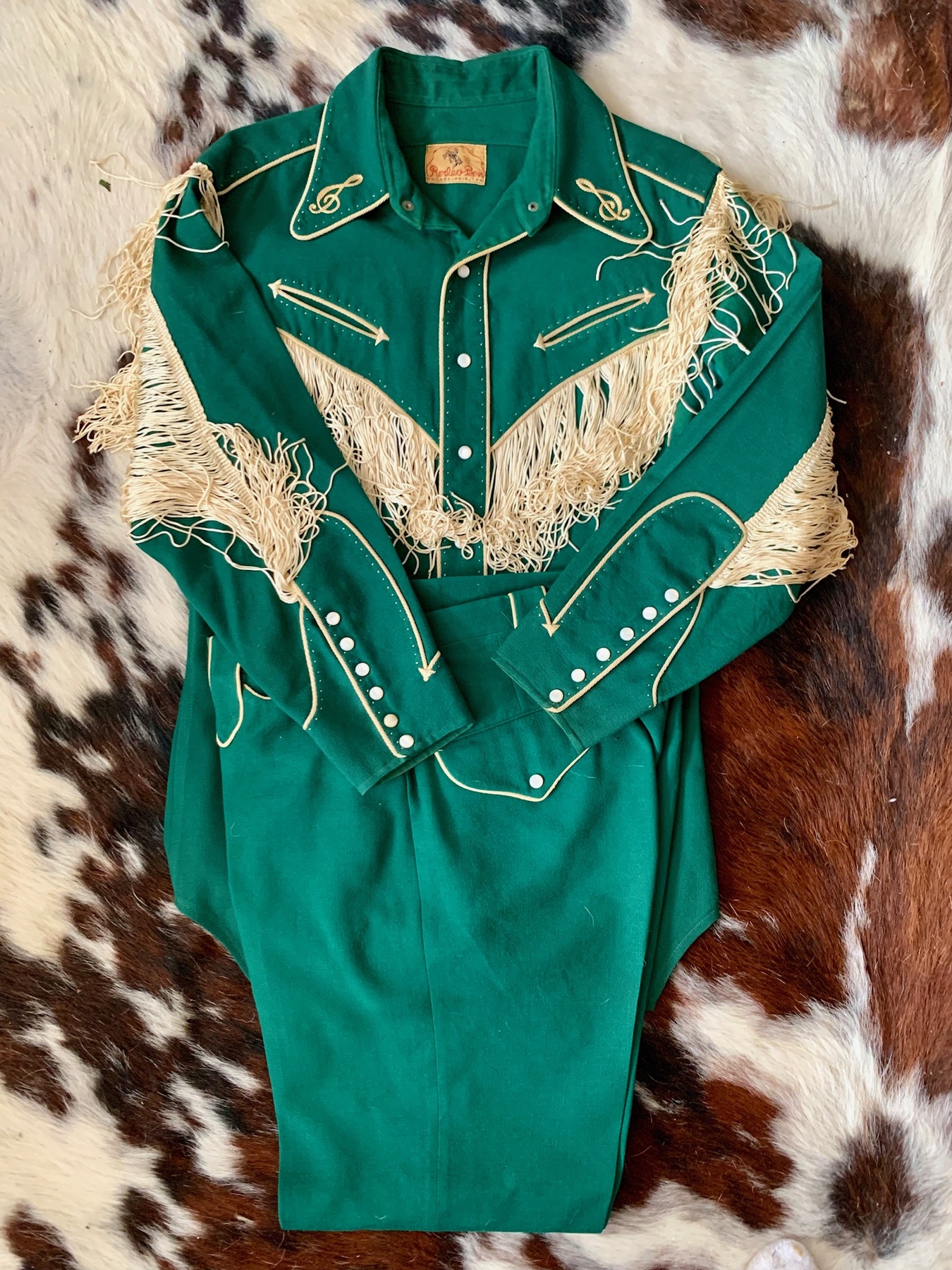
Rodeo Ben
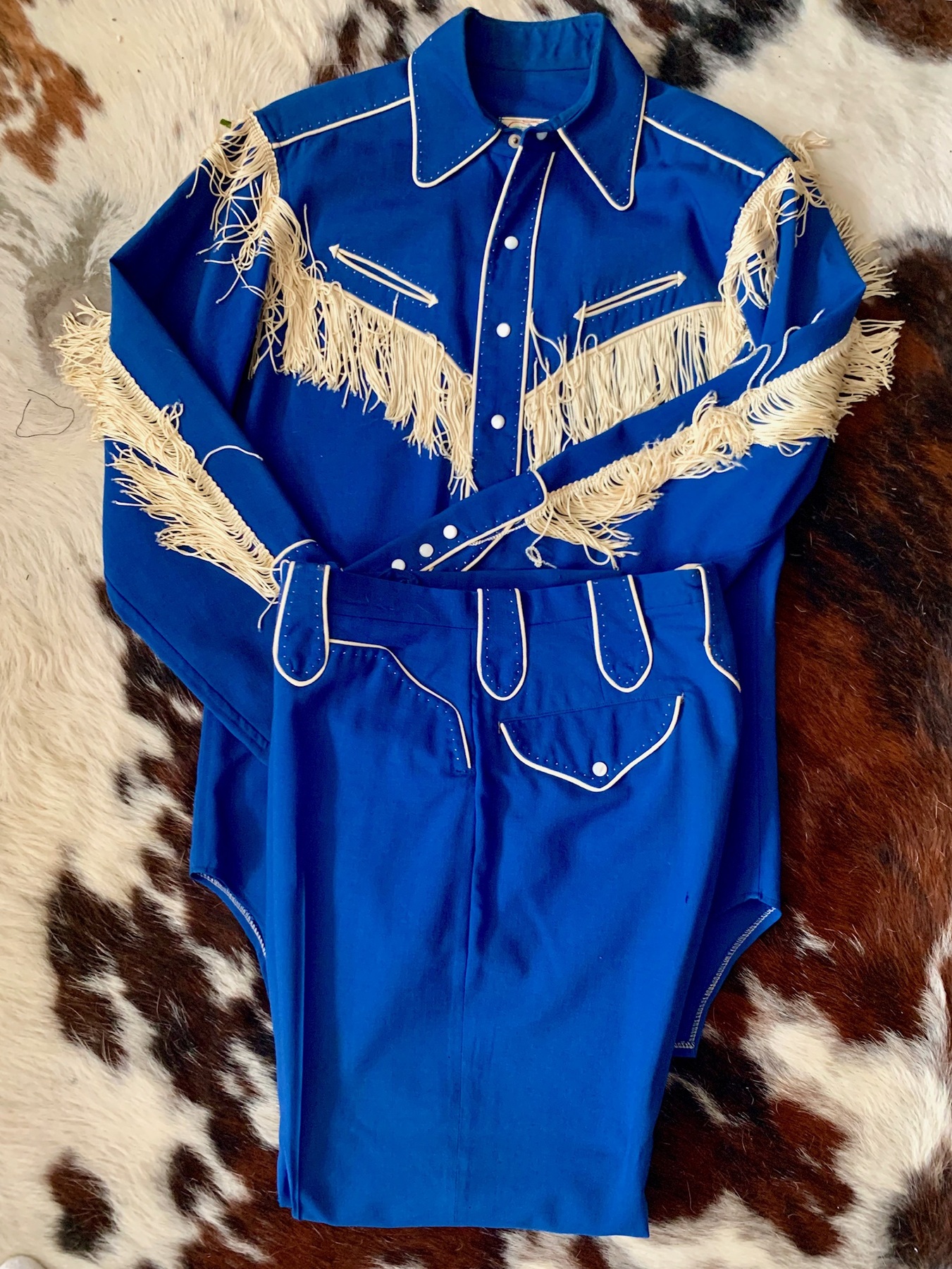
Blue fringed outfit
C03 · 1 photograph
Philadelphia · Made to measure
A tailor gives the travelling West a choice of clothes.
Start with the work. Follow the people who made and wore it.
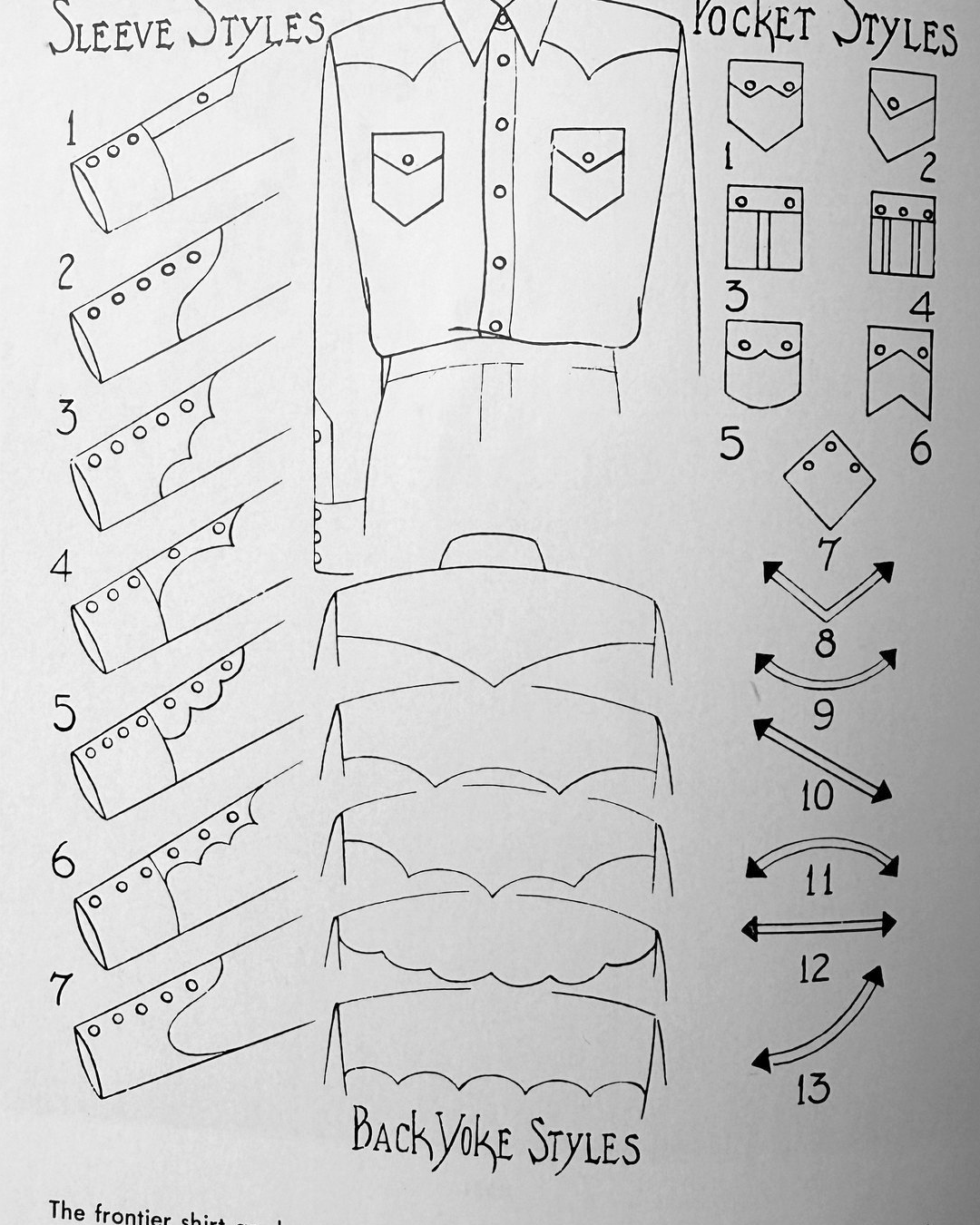
Open his catalogue at pages 38 and 39 and the showmanship pauses for a moment. There are drawings of sleeves, pockets, yokes and belt loops: a menu of ways to make a shirt or a pair of trousers belong to one person. A customer could choose the line across the shoulders, the turn of a pocket, the shape at a cuff. Then turn back through the book. The same vocabulary appears on a child's parade outfit, a singer's shirt, a man's business suit and a garment built to announce its wearer before a rodeo crowd. Rodeo Ben understood that Western dress was not one fixed costume. His Philadelphia shop sold the possibility of making it your own.
Choose the details
The catalogue offered a vocabulary a customer could put together: sleeve styles, pocket shapes and back yokes, with different ways to finish a shirt.
Explore the printed choices ↗Rodeo Ben catalogue, printed page 38.
The cover puts Bernard “Rodeo Ben” Lichtenstein at 6240 North Broad Street, Philadelphia. Inside, a signed letter speaks directly to the customer. Ben presents himself as a tailor who had learned sewing, patterns and textiles, travelled through the West, and built a staff that included his son. Those are his claims in a sales catalogue, and we have no dated imprint for this copy. Yet the pages themselves show what the business wanted a customer to see: a showroom, numbered designs, family members wearing them, performers associated with the shop, and a cutting table covered in paper patterns. It is an unusually intimate view of how a city tailor sold a very portable idea of the West.
Bernard Lichtenstein reached Philadelphia long before Rodeo Ben's catalogues reached the rodeo circuit. The Country Music Hall of Fame dates his birth in Poland to 1893 and says he arrived with his Jewish family at fourteen. It dates his Western-wear storefront to 1930. His catalogue letter later describes sewing, patterns and textiles in Ben's own sales voice. Those records give the business a human starting point without assigning any particular yoke or motif to his birthplace. He made his name by cutting, fitting and offering clothes for customers whose public idea of the West was still being made.
This is a boast, not a shipping ledger. The advertisements and catalogue let us see how he meant to make it true: carry the designs to a circuit of customers while the cutting and fitting stayed anchored in Philadelphia.
The contemporary trade trail begins here with a December 1936 Billboard advertisement. It offers a new catalogue to cowgirls and cowboys across the United States and Canada and prints 3209 North Columbia Avenue. A 1937 notice promises clothes made individually to personal measurement and prints West Columbia Avenue. The difference is real in the printed notices; the available record does not yet explain it. An address is a firmer foothold than a neat origin story, even when it leaves a question behind.
Those small ads reveal the business model. In 1938 the shop pitched made-to-order clothes for cowboys, cowgirls and children. The following April, another Billboard ad offered suits and pants to people in rodeos, circuses and cowboy bands, with a free catalogue. The museum says Ben made personal appearances at rodeo arenas too. A paper book extended that reach: it could show the clothes at another stop on the circuit, and a measurement could come back to Philadelphia. That was the promise in the advertisements; neither the museum summary nor the notices tell us how many orders arrived by either route.
The catalogue turns the promise into choices. Numbered outfits begin with shirts and trouser suits and move between sober lines, floral work, butterflies, stars, appliqué, fringe and rhinestones. Some pages offer drawings; others show a person in the finished clothes. The menu makes a crucial distinction visible: an illustration could propose a variation, while a photograph shows that at least a version was presented to the camera. Neither proves how many were made or who cut and stitched them.
In 1940 Ben advertised shirts, jackets, trousers, capes, boots and hats. By 1943 his ad called a completed new catalogue an “authentic Style Guide of the West.” That grand phrase is the shop's own pitch, but the range was concrete. A Western wardrobe included things to ride in, things to travel in, things to stand under lights in, and perhaps a suit for the hotel lobby after the show. The changing advertisements sold all of them.
There is a photograph in the catalogue that should interrupt any easy tale of one famous man making every stitch. Across a two-page spread, Ben and the man identified as Ben Jr. stand at a cutting table beside paper patterns. Cloth fills the shelves behind them. The caption claims that all the fashions in the book were personally designed by the pair and completed under their supervision. It does not name the rest of the staff whom the signed letter says the business had expanded to employ. The picture and the boast, read together, show both the workroom and the limits of a family brand's self-portrait.
Ben's daughters Claudia and Blossom model a skirt suit and a bolero-and-trouser set on another spread. His granddaughter Elise appears repeatedly: in a young child's parade suit, a later horseshoe outfit, a star-covered suit with fringe, a peacock or “Bird of Paradise” design, and a comparatively restrained two-tone shirt and trouser combination. The catalogue says she was four in one photograph and ten years older in the facing one; without an edition date, that sequence cannot become calendar years. The family pictures show who the shop placed in front of the camera. They do not, on their own, establish who managed orders, sewed embroidery or finished a garment.
That distinction matters because a label often tells us who sold the clothes while hiding the work that made them. The family performed the shop's identity for its customers. The cut of a yoke, a reinforced pocket point, the line of piping and the fit of a pair of trousers were accomplished in the workroom, whether or not the catalogue found room to name each worker.
Ben's catalogue calls Gene Autry a customer and prints him in a floral and butterfly shirt. Another page shows Autry with four people whom the caption calls his Jemez Indian friends. The printed language tells us how the shop framed that scene; it does not give us the four people's names or license us to treat them as anonymous costume scenery. The Autry Museum supplies a different kind of evidence: three accessioned shirts associated with Autry and attributed to Rodeo Ben. One brown, tan and cream wool-gabardine shirt, dated by the museum to the 1930s, carries horse-head appliqué, shaped pockets, embroidery, beads and sequins. A later silk shirt and scarf use orange piping and floral appliqué. A pink-and-yellow acetate shirt takes another route, with feathers, machine embroidery and rhinestones. The catalogue's portrait and the museum's garments show an association from different angles; they are not identified here as the same object.
Roy Rogers appears in the catalogue too. A page places him beside Jack Kriendler of New York's 21 Club in custom Western clothing; another has Jack and his wife in clothes the caption says were made for a Palm Springs holiday. A later group photograph identifies Ben Jr., Rogers, Ben Sr. and Glen Randall at a Madison Square Garden rodeo. These printed identifications have the authority of a shop speaking to its own customers, not of an independent order book. But they make the shop's range plain. Its West belonged to a film cowboy, a nightclub proprietor on holiday, a family modelling at home, and people who came to a rodeo in New York.
One photographed garment offers a narrower, tangible route into the Rogers story. In the 2010 Roy Rogers and Dale Evans Museum Collection sale, Christie’s presented a blue-yoked Rodeo Ben shirt with striped trousers and a red scarf as belonging to Roy. Stars, V shapes and floral stems connect the pale shirt to dark panels, piping and trouser trim. The auction attribution and label transcription belong to that lot. They do not prove that it is one of the outfits in Ben's catalogue or establish the full size of Rogers's wardrobe. The coordination is visible enough to show why a tailor would sell an ensemble rather than a solitary shirt.
Ben's customers were not limited to film and country music. In July 1947, Billboard's Bailey Bros. column reported that Opal Stevens had received three new outfits from “Ben, the rodeo tailor,” with hats and boots. Here is the travelling business in a single short item: clothes arriving in a circus life that could not wait for a Philadelphia shop to come along with the show. The report records a particular delivery, not a general contract with every circus performer.
Two facing pages near the back of the catalogue give Berva Dawn Taylor more than a passing appearance. In style #263, she stands in a star-trimmed parade suit with fringe falling from the sleeves. The shop calls her a rodeo performer from Camas, Idaho, the daughter of rodeo producer Doc Sorenson, and someone who had modelled its clothes around the circuit for years. The next page returns to her in a striped coat whose cloth the shop describes as a handwoven Mexican serape. The family link, duration and textile origin are Ben's printed claims. The pictures show how the business presented a woman who could carry its clothes before the very crowds it hoped to dress.
There is no single Rodeo Ben silhouette. The Country Music Hall of Fame presents a suit for Sky Snow with shaped yokes, smile pockets, piping and chain-stitched flowers; a Hawkshaw Hawkins bolero with a great hawk worked across the back; and a Skeets Yaney suit whose contrasting lapels and cuffs carry leaves and musical notes. Each takes a performer's image as its problem to solve. The museum's attribution is object-specific, and the clothes do not tell us which person proposed every motif.
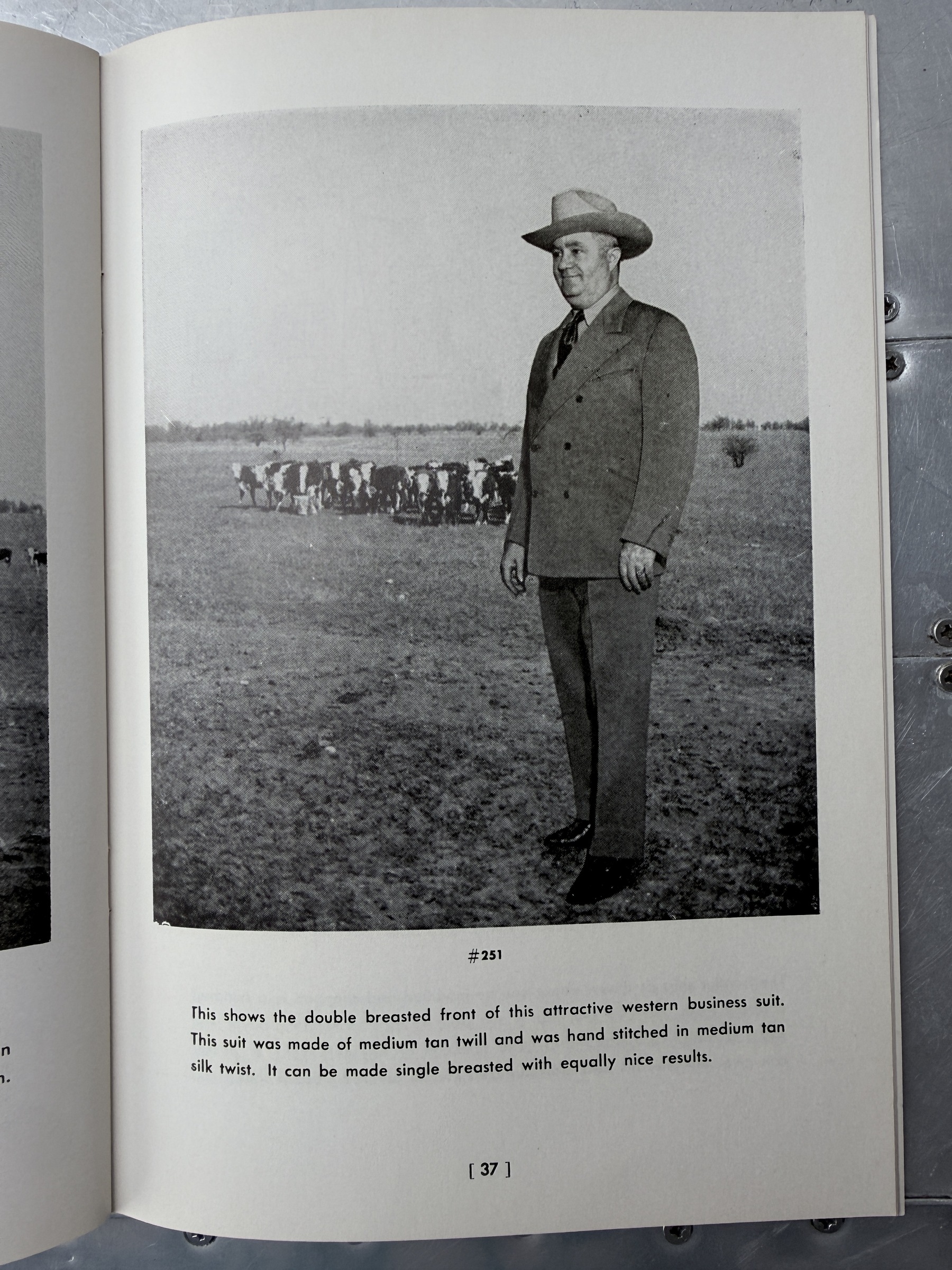
The catalogue makes the opposite end of the range visible. Ben Sr. and Ben Jr. model comparatively restrained street and business suits alongside the star suits. The work is still Western in cut and detail: arrow-like pocket treatment, piping, shaped fronts and a deliberate back. A buyer could ask the shop for spectacle, but also for a suit whose Western language was close enough to read at a table rather than from the far side of an arena.
One show shirt carries an Indigenous-head image, and another catalogue suit borrows Indigenous-themed signs from commercial Western fantasy. Those motifs belong to a non-Indigenous tailoring and entertainment context as presented here. Repeating the catalogue's period language without examining it would confuse theatrical borrowing with Indigenous authorship or dress. The more honest caption describes what is visible, names the shop that printed it, and leaves room for the larger history of the people whose cultures were used as imagery.
Blue Bell's 28 March 1949 LIFE advertisement carried a roping photograph of Gerald Roberts and printed the credit “Styled by Rodeo Ben, tailor to top rodeo stars!” That is a striking public move. The name built in a Philadelphia custom shop now travelled with Wrangler jeans to a national reader. It made the tailor's rodeo reputation part of a factory brand's appeal. The ad gives us the wording of the campaign; it does not open Blue Bell's design office, contract files or production line.
Taylor, the woman in the catalogue's paired portraits, enters the denim story through a later telling of her rodeo life. Tumbleweed Smith visited her in Texas and wrote in 2003 that she had been a sponsor girl at the 1949 Madison Square Garden rodeo, appearing at events and in radio and television interviews. She also modelled at style shows. Then Smith turns to Wrangler: he says Ben took her measurements and made the first women's pair for her. The Texas Rodeo Cowboy Hall of Fame likewise calls her the original Miss Blue Bell Wrangler and repeats the made-to-measure account. Smith's words are a report written decades later, not a quotation from Taylor on the jeans and not a Blue Bell work order. What his printed page lets us see is how a woman's rodeo career moved through the arena, the publicity circuit, fashion shows and a denim campaign; the precise making of the jeans remains outside the surviving record here.
An advertisement reproduced in a 2015 public-radio report lets us see how Blue Bell put her to work in print. The ad itself names “Berva Dawn Sorensen” and “Rodeo Performer.” She holds horse tack above a checked Western shirt, denim jeans and light boots. The copy sells a snug cut, several leg lengths and a choice of zipper position for women; it prints a $3.69 price for one women's denim option. Those are the manufacturer's claims in a particular advertisement. They show a factory brand borrowing a rodeo woman's public identity to make fit and Western credibility visible. The crop does not identify its original issue or date, and it does not credit Rodeo Ben. It cannot prove that he designed the jeans she wears, or that they were cut to the measurements remembered in the later accounts. The catalogue's parade suit and serape coat remain different clothes in a different sales setting. The person links the two scenes; no garment-level handoff has been established.
The relationship appears again in 1952 Texas reports that identify Ben as designer of Wrangler jeans-and-shirt sets presented to rodeo cowgirls. A 1953 Oregon retailer sold Wrangler denim shirts as “Styled by Rodeo Ben,” and Ben's own 1955 Billboard ad called him designer of Blue Bell Wrangler products. Those sources support repeated, specific public design and styling attributions. They do not tell us the extent of his contract, identify every garment he worked on, or prove that he invented the features of a complete denim line. In a history so often compressed into the phrase “he designed Wrangler,” the printed record is more interesting than the shortcut: different sellers and newspapers used his name in different moments to make a custom tailor's authority carry across mass retail.
Two 1952 press accounts describe a fire at the Philadelphia operation. A United Press dispatch reported Ben's estimate of damaged cloth and clothing; Billboard later described a rear-plant fire, destroyed sewing machines and costumes, and a recent Gene Autry visit concerning a summer wardrobe. The accounts are reports from different moments, with different details. Together they show why the shop's contents mattered: cloth awaiting cutting, machines on which work depended, and performance clothes in progress. A famous name in the report did not make the loss abstract.
The advertisements continued. In 1953 Ben still advertised custom clothes to entertainers, riders, television shows and musical groups from West Columbia Avenue. A later Country Music Who's Who directory lists 6240 North Broad Street, the address on the undated catalogue cover. That makes the Broad Street book later than at least some Columbia Avenue notices a reasonable line of inquiry, but not a proven date for this edition. The date must come from a dated imprint or a dependable external match, not from the temptation to make an undated photograph fit a tidy chronology.
The 1973 federal trademark registration adds an unexpected family coda. It describes RODEO BEN as the trade name of a Philadelphia partnership and says it was a pseudonym used by Bernard Lichtenstein, Ben Sr., and Gerson Lichtenstein, Ben Jr., as designers of Western-style clothing. The filing preserves the names and the stated business form in a legal record. Its first-use claim is a registrant's assertion, not an independent reconstruction of 1935 or proof that the shop kept exactly the same shape through every decade.
The famous names can drown out the shop's more enduring idea. An immigrant who reached Philadelphia as a boy built a Western-wear business from an eastern workroom, a family name, arena visits and a catalogue of choices. The cut could be restrained or theatrical; the customer could be a screen cowboy, a circus performer, a child, or a woman travelling the rodeo circuit. Those differences are the point. Turn once more to the design menus: pockets, yokes, sleeves and belt loops offered as decisions a buyer could make. We cannot count every garment or name every worker. We can see the proposed route from a printed option and a set of measurements to clothing made for one person. That is a richer achievement than dressing the famous alone.
More clothes. More people. More choices.
A Billboard advertisement of 29 September 1951 offered individually tailored Western clothes to performers, riders, showmen, television, rodeos, Western-show classes and musical groups. It printed 3209 West Columbia Avenue, Philadelphia. The notice is the business speaking for itself, but it keeps the shop’s address and intended clientele visible in the trade press at a later moment.
The undated Rodeo Ben catalogue is held in the archive. Catalogue identifications remain attributed to its printed captions.
From Joe’s archive
 Meet the people ↗