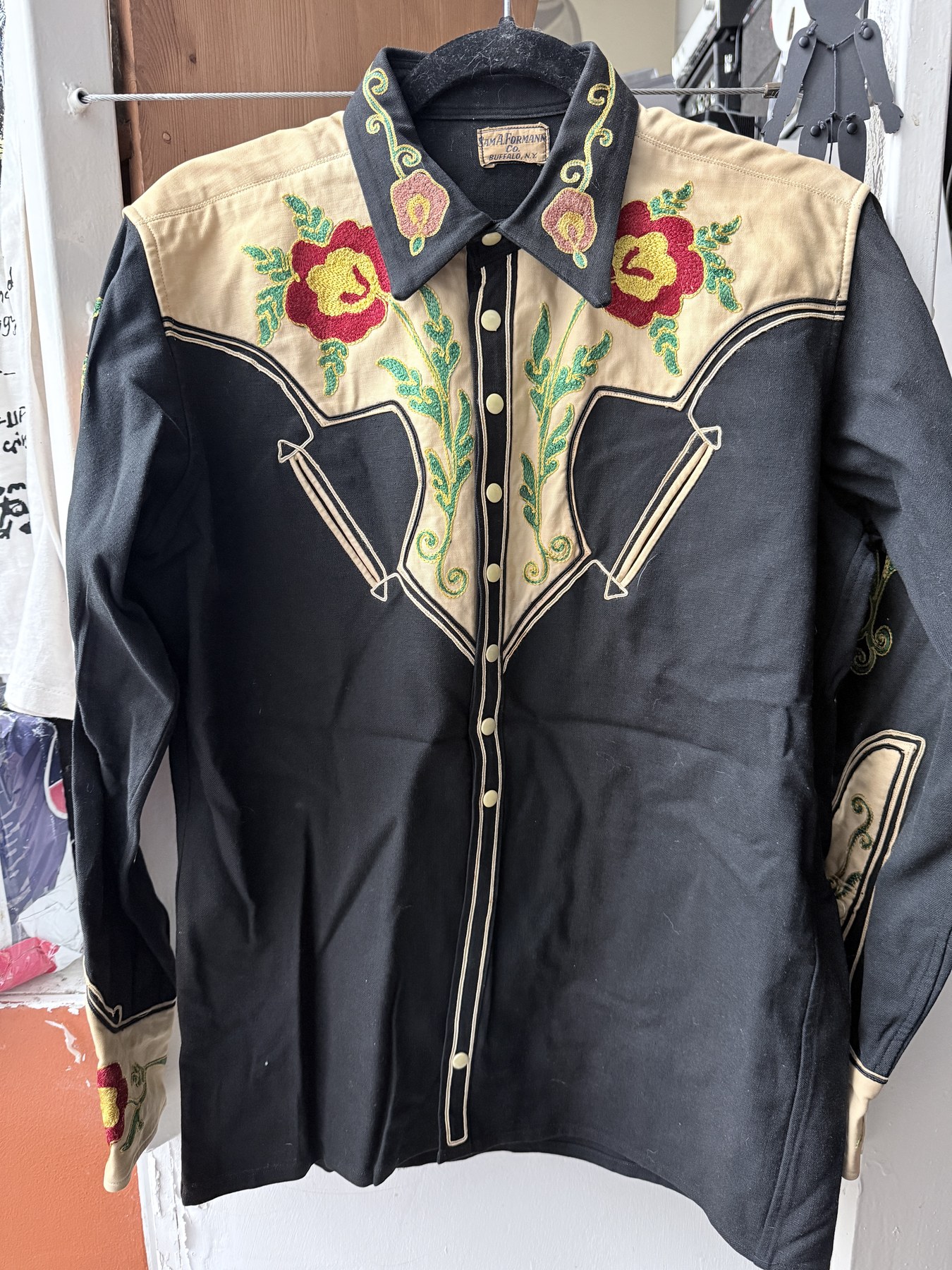
A shirt can arrive ahead of its paperwork. This one comes in black and cream, with roses climbing from its collar across the shoulders and down into its cuffs. Inside is a woven label: “SAM A. FORMANN / CO. / BUFFALO, N.Y.” It is the first object in Western Wear History’s Sam Formann record, photographed for the collection without a personal credit. The label gives us the exact company form and the city printed on this particular garment. It does not yet give us a date, a shop address, an owner, a production count or a biography.1
A line from the road
The label is no longer the only thread. In announcing its 2021 Bill Anderson exhibition, the Country Music Hall of Fame and Museum identified rhinestone-studded suits from the early 1960s designed by S. A. Formann, a Buffalo, New York tailor; it said Anderson had bought the stage costumes by mail order. That puts a real route behind the surviving shirt: from a Buffalo label to a country singer’s stage wardrobe, carried through the post rather than the shop door.2
The museum’s account names the tailor, city, performer, decade and mail-order purchase, but it does not settle the company’s founding, its street address, its ownership, or the production story of every Formann label. Those are the Buffalo records still worth chasing.2
The yoke is the calling card
The garment is constructed to make its geometry visible. A cream shoulder panel comes to pronounced points at the chest and back, framed in narrow double piping against black cloth. The front pockets repeat the same language: deep angular shapes, each crossed by an arrow-like bar. Pale snap fasteners carry the eye down the placket. It is a strong enough system of cut and trim to make this shirt useful as a comparison piece when other Formann-labelled clothes turn up. One garment, however, is a reference point rather than proof of a maker-wide signature.1
The collar and yoke are worked with large red and pale-yellow roses, green leaves and curling yellow outlines. The same floral vocabulary crosses the back and returns at the cuffs. It is not simply ornament laid on a plain shirt. The embroidery follows the garment’s seams, collars, points and openings, using the structure of the shirt as part of the drawing.1
Read the label, then keep looking
The small label is the firmest piece of evidence here. It visibly names “Sam A. Formann Co.” and “Buffalo, N.Y.” Its visible design and construction can be described from the photographs. Beyond that, the record is deliberately open: no date has been assigned, and no claim is made yet about who cut it, embroidered it, sold it or wore it. The next task is to bring this object into conversation with city directories, advertisements, catalogues, performer wardrobes and other labelled garments.1
The back close-up shows why the object deserves that work. Its rosework is organised around a sharply pointed cream yoke, while the black sleeves and body give the colour and thread a stage of their own. The national census of custom Western makers begins with details like these: a label that fixes a place, a garment that preserves a visual vocabulary, and enough humility to let the next document change the story.1
The two remaining views preserve the collar’s floral border and the relation of its panels to the front closure. They are here for close looking and future comparison, not to make an unearned date chart.1