Buffalo · Cut & embroidery
Sam A. Formann.
Buffalo shirts built around the yoke
The arrow pocket. The rose. The Buffalo label.
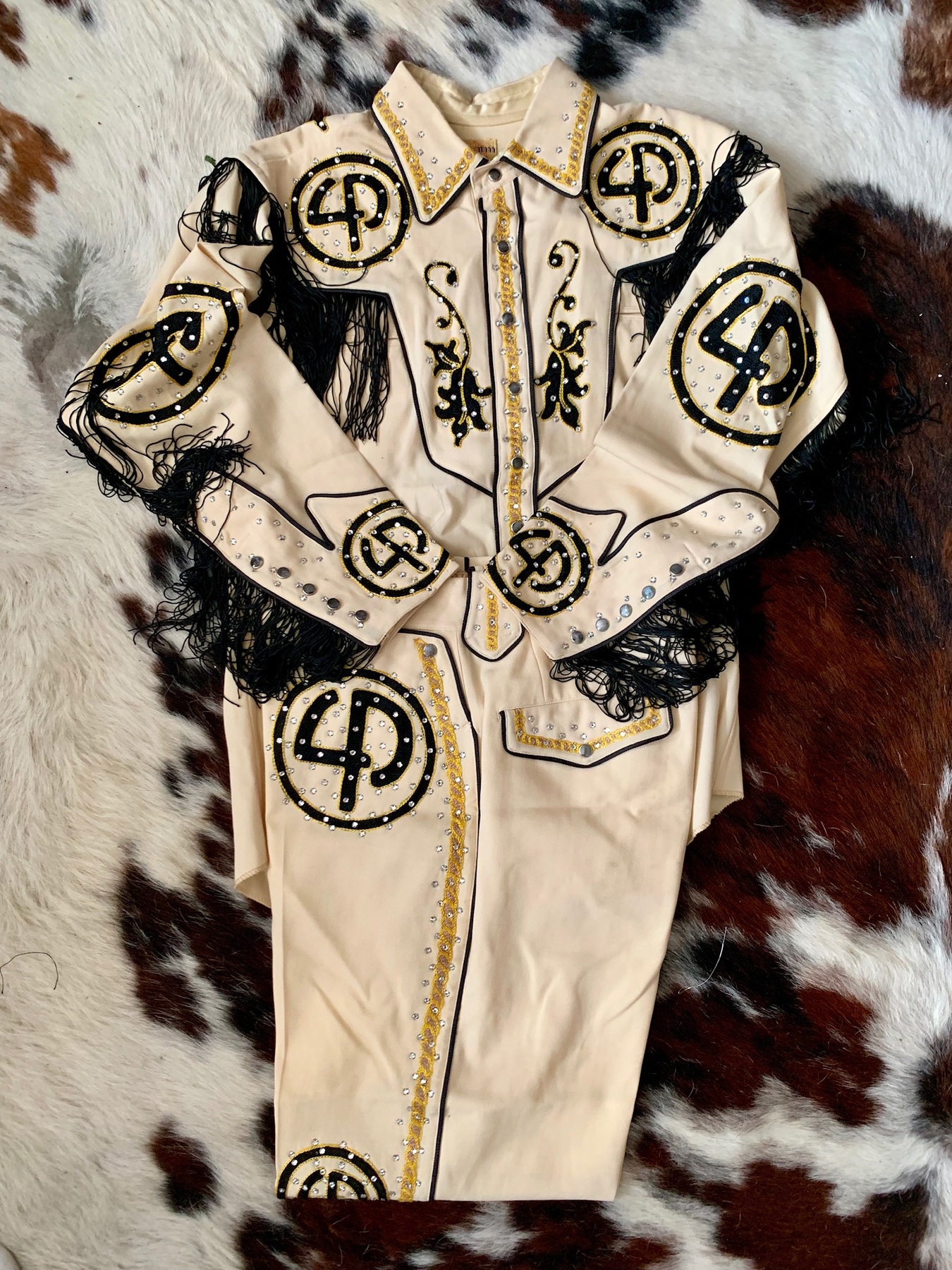
The first thing the black-and-cream shirt tells us is where its maker wanted the name to land. A small woven label sits just inside the collar: “SAM A. FORMANN / CO. / BUFFALO, N.Y.” The shirt itself opens outward from that quiet rectangle. A cream yoke sweeps over the shoulders and down into long points. Dark piping traces its edge twice. Red and yellow roses climb the front on green stems; the pockets echo the yoke in smaller angles; the collar and cuffs carry their own embroidery.
It is a useful way into Sam A. Formann’s story because the label is firm and the biography is not. The photographed shirt connects a particular garment to a company name and a city. It does not give us an address, a date, a customer, or the name of the person who cut, sewed or embroidered it. The work on the shirt is visible; the workroom behind it has not yet come fully into view.
That distinction is not a disappointment. It is a way of reading the surviving evidence honestly. A maker’s name appears inside the collar, and the garment makes a strong case for looking closely at how Formann shirts were designed and finished. The paper trail remains thin enough that we should not invent a shop, a family history or a career to fill the silence.
A photograph from 2008, and a question of identity
An earlier photograph may show this very shirt. Augusta Auctions' October 2008 lot 683 grouped two Formann-labelled men's shirts. One is black with a cream yoke. In its catalogue view, two red-and-yellow roses rise above the same deep, double-outlined yoke and angled pocket openings seen in the present collection photograph. The collar's floral embroidery and the pale, embroidered cuffs also agree. This is a much closer comparison than a shared house style.
But photographs can establish resemblance more readily than ownership. The auction image is small; the owner photographs were taken years later; there is no sale receipt, lot tag, back view from the auction, or intervening custody record in the current dossier. The auction described worn paint on the snaps, while the present photographs show pale snaps; that difference needs direct inspection rather than a story about repair. It remains possible that this is the same garment, but the article cannot present the auction as a proven chapter in its provenance.
The distinction changes how we count the surviving objects. Lot 683 documents a black-and-cream shirt and a blue-grey shirt; the black-and-cream catalogue image may overlap the owner example. We should not count it as a third independent shirt merely because it appears in another photograph. The auction's 1940s date remains the auction house's attribution; the visible image itself establishes only that its photographed shirt was in the 2008 sale.
The line that gives the shirt its shape
Tyler Beard’s 100 Years of Western Wear described a Formann shirt from the Tom Bailey collection as a yellow and hot-pink wool gabardine garment. He singled out its exaggerated geometric scoop yoke and silk-cord top trim at the collar and cuffs. The description makes a point that the owner shirt helps clarify: the yoke was not just a patch of contrasting cloth. It was a drawn line, deep and deliberate, which the cord made even sharper.
The photographed black-and-cream shirt carries that geometry in a different way. Here, the cream panel descends toward the pockets, while twin piping follows its path. The rose stems cross the pale field instead of sitting apart as a badge. On the back, flowers spread laterally across the shoulders. The shirt is decorated, but its decoration is organised by its tailoring: seams, borders, pockets and cuffs give the embroidery somewhere to travel.
Augusta Auctions’ 2008 catalogue offers a second view of the design and a contrasting Formann shirt. Lot 683 brought together two men’s wool-gabardine Western shirts that the catalogue dated to the 1940s. The auction described exaggerated scooped yokes and cuffs with colourful chain-stitch embroidery: one cream on black, visually close to the owner shirt, and the other blue on blue-grey. Its label photographs show the Buffalo wording. The listing preserves the auction’s descriptions and visible labels, not an independently documented manufacture date or a proven chain from that sale to the present owner. The blue-grey shirt gives us a separate colour arrangement; the black-and-cream image may be another view of an already-counted object.
Lot 701 was a women’s blouse, also dated by the auction to the 1940s. Its description names a black wool-twill body, a cream sculpted yoke and cuff, peach roses, green stems and leaves, twisted-cord accents, slash pockets and a six-snap shotgun cuff. The auction transcribed the label as “S. A. FORMANN CO INC. BUFFALO N.Y.” That fuller wording matters because it adds “Inc.” to the more compact “Sam A. Formann Co.” label visible in the owner-photographed shirt. It is still a catalogue transcription attached to a particular lot, not proof of incorporation date or business structure.
Across these garments, the visual family becomes more legible without turning into a rule. Scooped or pointed yokes, cord outlines, careful cuff work and flowers recur, but the details shift. The decoration might be a trio of roses on a pale panel, a dense embroidered design against a darker shirt, or the geometry of a broad yoke outlined with silk cord. We can recognise a body of work while leaving open which elements came from a house pattern, an individual customer’s request, or the hands of different workshop workers.
A Buffalo name on a Nashville stage
A shirt can preserve a maker's name without preserving its wearer's. In this case, another wardrobe brings a customer into view. The Country Music Hall of Fame and Museum's 2021 exhibition announcement identifies rhinestone suits worn by Bill Anderson in the 1960s as designs by S. A. Formann of Buffalo and Nudie's Rodeo Tailors. It names both makers within one performer's stage wardrobe; it does not say which particular suit belongs to which maker.
That is enough to widen the story. The label inside the owner-photographed shirt speaks from Buffalo. The museum's announcement places the Formann name in the clothes of a singer whose work was seen far beyond that city. A shaped yoke, embroidery and rhinestones served different parts of a performer's image, and Formann appears in records for both Western shirts and stage suits. Their connection is the maker name, not proof that the same person cut or embellished every piece.
The museum's former exhibition page went further. A search-indexed capture of its now-retired page described an Anderson suit with snowflakes and said he ordered Formann costumes by mail. The URL now redirects to a general calendar, so that richer account belongs in our research notes until a stable archival or object record can be secured. The live museum announcement supports the narrower claim in this chapter: Formann was one of the designers credited for Anderson's 1960s stage clothes. No order form, price, workroom roster or garment-by-garment attribution has been established here.
A tailor whose archive is still missing
The present evidence is a compact set of encounters: the owner-photographed Buffalo label; Beard’s published description of a Formann shirt; two 2008 auction lots, with one lot 683 image possibly showing the owner shirt; and the museum's live announcement of Bill Anderson's 1960s stage costumes. Together, they tell us more about Formann’s output and reach than we can say about his life or the structure of the company.
We do not yet have a securely dated business directory entry, shop address, company catalogue, trade advertisement, order book, correspondence, or a run of dated garment records. The auction descriptions place particular pieces in the 1940s, but their dating remains auction attribution. The owner shirt has not been independently dated here. The museum's live announcement establishes a stage-costume connection in the 1960s, but not a complete operating chronology or the mechanics of Anderson's orders.
That gap should guide the next research rather than flatten the story. Buffalo city directories, garment-industry records, trademark and corporate filings, regional newspaper advertising, or the original account behind the Anderson exhibition text could provide dates and a more precise picture of the shop. A dated trade catalogue might tell us whether customers selected a stock design, ordered variations or commissioned entirely new work. Until those materials surface, we should not turn likely business practice into biography.
What we can say is worth keeping. A shirt marked “Sam A. Formann Co.” carries a distinctive cut and a carefully placed floral surface. Other Formann-labelled garments show related yokes and corded edges in different colours and forms. A museum announcement places the Buffalo name among the makers of Bill Anderson's 1960s stage wardrobe. The name travelled farther than the surviving paper trail, and the clothes still show how it looked when that name was sewn inside.
Stay with the details.
Sources & further reading
- Western Wear History Collection, Sam A. Formann Co. shirt photographs, submitted 29 September 2026
- Tyler Beard, 100 Years of Western Wear (Gibbs-Smith, 1993), p. 102
- Augusta Auctions, October 2008 Vintage Clothing & Textile Auction, lot 683, “2 Cowboy Wool Gab Western Shirts, 1940s”
- Augusta Auctions, October 2008 Vintage Clothing & Textile Auction, lot 701, “Cowgirl Embroidered Western Blouse, 1940s”
- Country Music Hall of Fame and Museum, “Country Music Hall of Fame® and Museum to Open New Exhibition Bill Anderson: As Far as I Can See,” 1 November 2021