California · Embroidery
Viola Grae.
her name in the work
A name stitched into the work.
A cream shirt carries red roses across its shoulders and down its sleeves. On a pair of green boots, embroidered hearts tumble from a wall. Viola Grae could make thread describe a flower, tell a joke or turn a song into a picture. Her name belongs beside those clothes, not only behind the better-known shop signs.
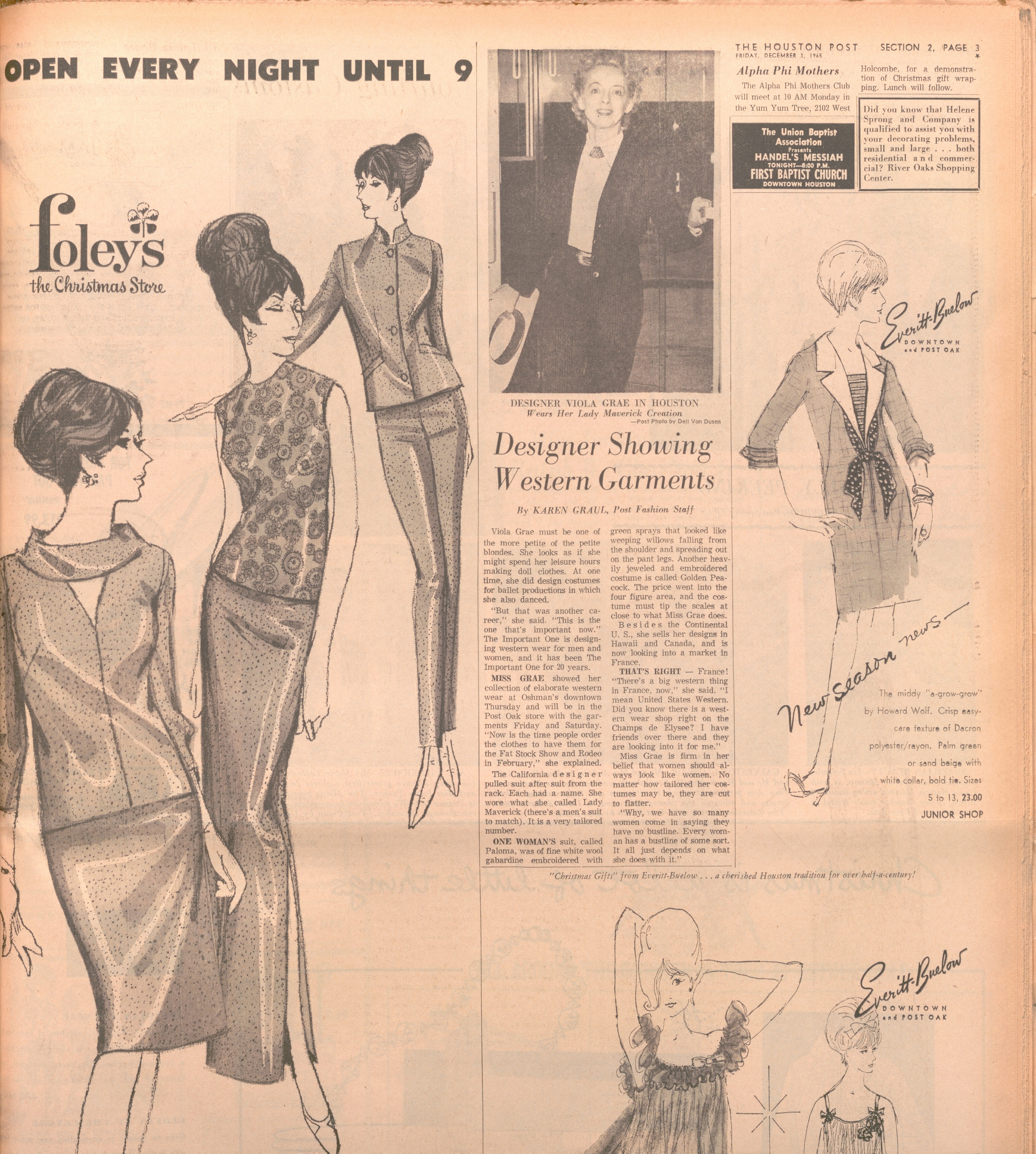
She was also a designer with a collection of her own. In Houston in December 1965, she showed customers suits named Lady Maverick, Paloma and Golden Peacock. The clothes on the rack ranged from sharp tailoring to lavish embroidery, made for women and men who were planning what to wear to the rodeo.
A wardrobe with names.
In December 1965, Viola Grae brought a rack of Western clothes to Oshman’s in Houston. She showed the collection at the downtown store on Thursday, then took it to the Post Oak store for Friday and Saturday. Customers were ordering ahead for February’s Fat Stock Show and Rodeo. Here was Western wear as a seasonal wardrobe: chosen in a shop, made to order and anticipated months before the occasion.
Every suit had a name. Grae wore Lady Maverick, a sharply tailored outfit with a matching men’s suit in the collection. Paloma was white wool gabardine embroidered with green sprays that fell from the shoulder and spread over the trouser legs like weeping willow branches. The heavily embroidered and jewelled Golden Peacock reached a four-figure price. These were different ways of dressing Western, from close tailoring to extravagant decoration.
Talking to Houston Post fashion writer Karen Graul, Grae recalled designing costumes for ballet productions in which she had also danced. Western clothes for men and women had since become her main work; the article described a career of twenty years in that field. Her clothes already sold beyond the continental United States, in Hawaii and Canada. She was exploring France, where friends were investigating a possible market for her.
The interview brings Grae into focus as a designer selling her own collection, talking about fit and preparing for the next season. Her embroidery belonged to famous workrooms, but her ambition was not confined to somebody else’s label.
Karen Graul, “Designer Showing Western Garments,” The Houston Post, 3 December 1965, section 2, page 3. Photograph by Dell Van Dusen. Scans supplied by the owner from Harris County.
The song on a boot
In 1948 Hank Thompson had a hit with “Humpty Dumpty Heart.” The song’s title also became an embroidered picture on boots made through Nudie’s Rodeo Tailors. The museum does not date the boots. On their green shafts, little orange hearts with faces perch beside a yellow brick wall. One looks ready to fall. Dark red shapes arch above them; below, broken hearts mark the pale leather toes. The scene is playful enough to read quickly and skilled enough to bear close looking. The Country Music Hall of Fame identifies the boots as Thompson’s and credits the fantastical embroidered scene to Viola Grae.
A song is heard in time. A stage image has to tell its story at once. Grae found a scale that works on the boot: hearts large enough to recognise in the photographed object, a wall that makes the joke legible, stitches following the leather’s curves. That work turns a familiar title into a character one could carry across a stage. Its maker’s name is preserved by a museum credit on this particular object. That is more precise, and more valuable, than treating every embroidered Nudie garment as hers.
The boots also unsettle the easy language of authorship. The museum presents them as Nudie boots made for Thompson. His song supplied the subject. Grae made the scene that lets the song appear on leather. Each part matters; none erases the others. If the workshop label is the only name a history records, the design’s most vivid labour disappears.
The master in the workroom
The Autry Museum’s finding aid for the Nudie’s Rodeo Tailors archives names Viola Grae and Rose Clements as master embroiderers in the shop’s workroom. It also names other specialists, including Manuel Cuevas and Jaime Castaneda. This is a rare glimpse past the sign over the door. A Western suit could be conceived, measured, cut, stitched, fitted and embellished by more than one person, while its public identity remained a single tailor’s name.
The sewing machine does not make that labour automatic. In a 2026 musicological essay on Nudie’s Singer machine and the clothes made with it, Chelsea Burns draws attention to measuring, cutting, choosing cloth and colour, and the handwork of employees such as Grae alongside machine stitching. That is an interpretive reading of the workroom, not a newly found time sheet or a list of who made each garment. It is still a useful way to look: the machine is part of the story, but so are the hands deciding where a stitch should go and what a stage audience would see.
The museum places Rose Clements’s arrival in Los Angeles in 1963 and says she took on the embroidery role Grae had held. It also credits Grae with Thompson’s boot scene, though it gives the boots no date. The two women have names in the record where a workshop history too often offers only the shop sign. The account leaves the exact changeover open; the boots give one maker a precise credit.
The old narrative has a habit of calling a maker “the man behind the look.” The phrase is useful until it hides the people at the machines. Grae’s credits make a better question possible: which hands made the part of the garment that caught the eye? For Thompson’s boots, we can answer. For many other clothes, the archive has yet to tell us.
A shop that served other shops
Grae’s work did not stop at one shop door. The Autry archive names her among Nudie’s master embroiderers. A Tennessee resolution later describes the studio where she taught Manuel Cuevas as her studio. Tyler Beard’s 100 Years of Western Wear gives the wider account: a woman from Minnesota running an embroidery business in Los Angeles, with work sent to her by Western tailors including Nathan Turk and Rodeo Ben. Those are Beard’s reported business connections, while the museum and resolution describe particular parts of her working life. Together they reveal a craft with more than one address.
Beard follows her advertising through rodeo programmes and Western Horseman as late as 1966, and places her retirement in the early 1970s. The original advertisements have yet to join the collection, so their precise wording and dates remain in his account. Even there, the picture is of a specialist seeking customers under her own name, while shop histories often remember her beneath someone else’s.
The photographs make that network tangible at a smaller scale. An auction-presented Walking Box Brand ensemble carries Bell’s label and, separately, a credit to Grae for its embroidery. It cannot tell us how long the two businesses worked together. It can show a single garment carrying the traces of both. A suit could have a famous name at the collar and another maker’s work written into the cloth.
A name that travelled with the garment
“Viola Grae / California” appears inside an auction-presented embroidered shirt. The same wording is visible in a seller’s photographs of a black Western jacket. In the site archive, other auction views bring that label into sharp focus. Grae is the spelling on these photographed sewn labels; Gray appears as a variant in later retellings, so the garment evidence sets the heading here.
A cream shirt from a Kerry Taylor Auctions lot carries red roses on the collar, front, sleeves and back. Green stems curl around the two breast pockets; rhinestones catch light inside the flowers. The design is generous without losing the shirt’s shape: blossoms climb the cloth but leave space for the eye to follow each spray. Inside is the Grae label, and another bears “Dick Christensen” with measurements. That second name belongs to the garment’s history; the photograph alone does not tell us whether Christensen ordered, owned or wore it.
A second auction-presented shirt turns the register from cream and red to deep burgundy and gold. Pairs of yellow flowers sit among small rhinestone constellations. Its sewn Grae label has a second label beneath it reading “Buddy Brady 1.” Again, that is an object fact, not a biography of the named person. The two shirts together show range: the spare, climbing rose composition on light cloth and compact gold blossoms held against a dark field. Neither needs a famous wearer to be worth studying.
These are commercial presentations of surviving objects, not accessioned museum files. Their photographed labels are visible evidence; their assigned dates and stories of ownership need separate support. But the repeated presence of her name in cloth is important. Grae was not only someone a museum later recalled as a member of another person’s workshop. Her name could travel with a garment of its own.
Beside another brand
An Augusta Auctions ensemble adds a different kind of signature. One label names Rex Bell’s Walking Box Brand; a separate embroidered credit reads “Embroidered by Viola Grae.” The embroidered wording credits Grae for embroidery; a separate sewn label bears Bell’s Walking Box Brand. The photographs give us those two names on one auction-presented ensemble, without telling us who devised the motifs, cut the clothes, or sold this particular example.
It is a small inscription with a large implication. A Western-wear history organised only by shop labels will tend to divide the field into competing famous men. The “embroidered by” credit reveals another map beneath it: a specialist could contribute to work presented under a different company’s mark. Beard later wrote that Bell’s Western-wear stores sold clothes embroidered by Grae. No store inventory or invoice has been examined here. The photographed ensemble documents one object carrying both names; it does not establish the size or duration of their business relationship.
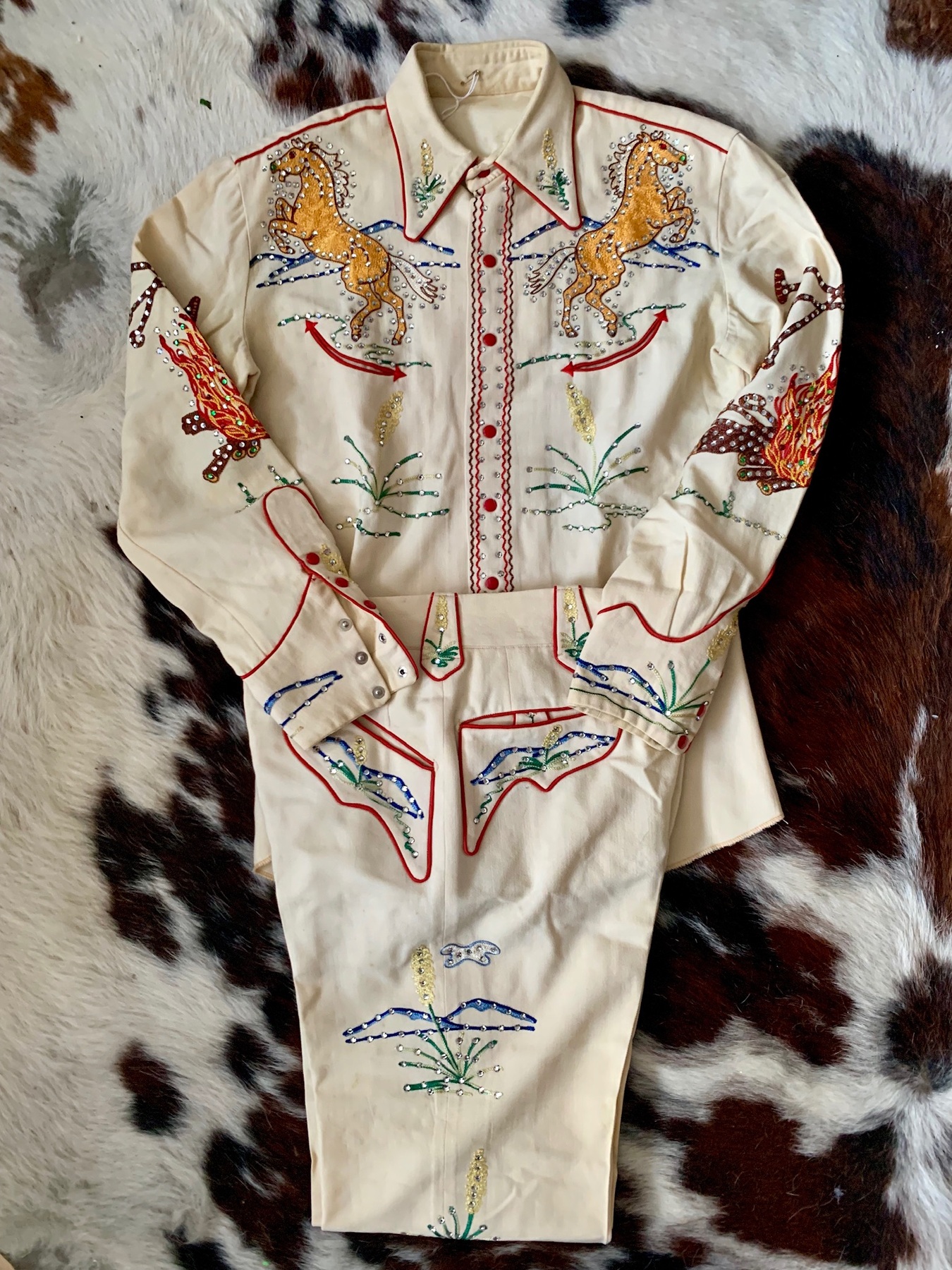
A cream suit in a private collection makes its case across three views. On the shirt front, two gold-coloured horses rise above red arrows; red piping draws the eye along the garment’s edges, while decoration carries across the sleeves and pocket flaps. Turn the shirt around and the horses enter a wider scene: blue landscape shapes, a fence, plants and small points of light spread across the back. The trousers continue the composition with smaller plant and landscape forms and a fire motif. Seen in sequence, the photographs show a design built for movement and for more than one angle of attention. That is a reading of the visible garment, not proof of who drew or stitched it.
The collection identifies the tailoring as Nathan Turk’s and attributes the embroidery to Grae, pointing to a small `VG` hidden in the work. The three overview photographs do not show a legible signature or maker label, and the collection’s underlying attribution research has not yet been attached to this object record. The wearer, occasion and date remain open. Set beside the Walking Box credit, the suit invites us to look for more than one maker in an object; it cannot, on these photographs alone, document a particular Turk–Grae commission.
Auction descriptions also extend Grae’s list of collaborators to celebrated tailors, including Rodeo Ben. They are leads to objects, not a licence to assign her every fine embroidery in Los Angeles. Her documented credits and the specific collection attributions deserve their own exactness.
A master found at the parade
Manuel Cuevas was doing Hollywood fittings when a trip to the Pasadena Rose Parade pulled his attention toward the embroidered clothes passing in front of him. He found out that Viola Grae had made the work he admired and sought her out. In his later account, he went to work with her and learned by listening to a master. The public spectacle led him back to the person at the machine.
A Tennessee resolution records that Grae taught him embroidery-machine work in her studio. Katherine Laidlaw’s 2024 interview profile adds a reported bargain: pattern cutting from Manuel in exchange for embroidery lessons from Grae. It has the shape of a working relationship, each bringing a skill the other could use. The exchange comes to us through a later telling; Manuel’s first-person interview and the resolution also place his apprenticeship with Grae.
Retellings often make the parade a prelude to Manuel’s fame. Turn the view around. Before that career, Grae’s embroidery had already found its way into public view and made another skilled tailor ask who could teach him. Her authority did not begin with his discovery of it. His memory preserves the route by which her craft passed to a younger maker.
The woman at the door
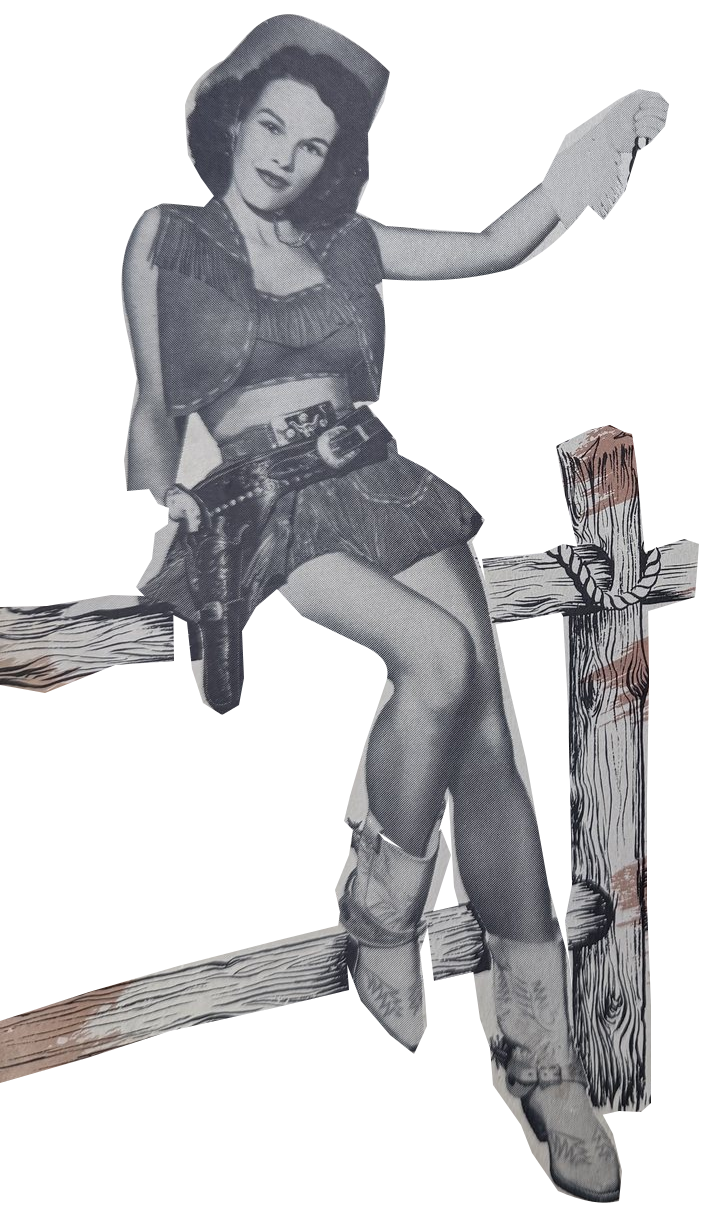
In the Houston photograph, Grae wears Lady Maverick herself. The newspaper interview places that image in the life of a working collection: a visit to Oshman’s, orders for the coming rodeo and a designer explaining her clothes. Her own wardrobe and her customers’ choices were part of the same business.
The word maverick is easy to make sentimental. Her surviving work is more exacting. It can turn a song into an image on curved leather. It can make red roses climb a cream shirt without drowning its construction. It can place a craft credit beside someone else’s brand and teach another maker to command a machine. Those are different kinds of authorship, each with its own evidence.
The record has not yet yielded a complete life: her childhood, training, business papers and last years still have empty spaces. But the boots name her work on leather; the labels keep her name inside shirts; the Walking Box credit sets it beside another brand; and Manuel’s recollection preserves her teaching. They place her at the centre of the making, where the famous faces and shop signs can no longer hide her.
Sources & further reading
- Karen Graul, “Designer Showing Western Garments,” The Houston Post, 3 December 1965, section 2, page 3; owner-supplied Harris County scan
- Augusta Auctions, October 2008 past-sale listings, lots 694, 696, 697 and 700
- Augusta Auctions, Rex Bell’s Walking Box Brand ensemble
- Online Archive of California, *Nudie’s Rodeo Tailors Archives, 1950–1994*
- CMHOF, “Nudie Cohn: The Original Rhinestone Cowboy”
- Owner-held Houston Post press photograph of Viola Grae; reverse caption credits Dell Van Dusen
- Chelsea Burns, “At the Country Music Hall of Fame with Nudie Cohn’s Singer,” in “Touching Music,” *Journal of the American Musicological Society* 79, Supplement 1 (June 2026)
- Kerry Taylor Auctions, lot 282, *Viola Grae and Globe Taylors men’s embellished shirts*
- Kerry Taylor Auctions, lot 113, burgundy wool shirt with Viola Grae label
- Katherine Laidlaw, “The 90-year-old man who built a western wear empire,” The Hustle, 1 October 2024
- Of the Palms, *1950s Viola Grae Hand Embellished Inky Black Western Jacket*
- Tennessee Department of Tourist Development / Country Music Hall of Fame and Museum, “Launch of Two Online Exhibitions”
- Tennessee Joint Resolution 998
- Anja Aronowsky Cronberg, “The Colour of Oil and Money,” *Vestoj*