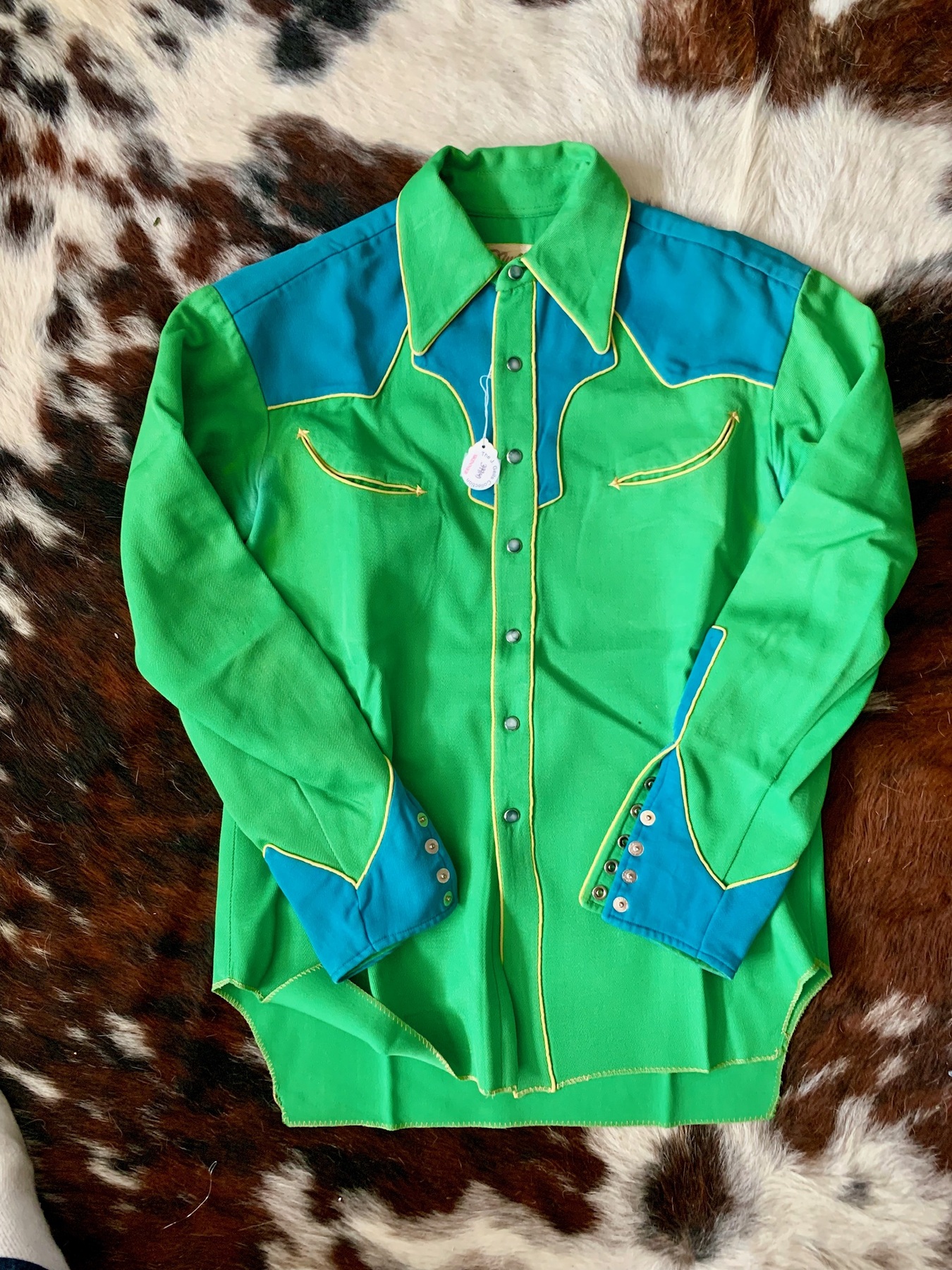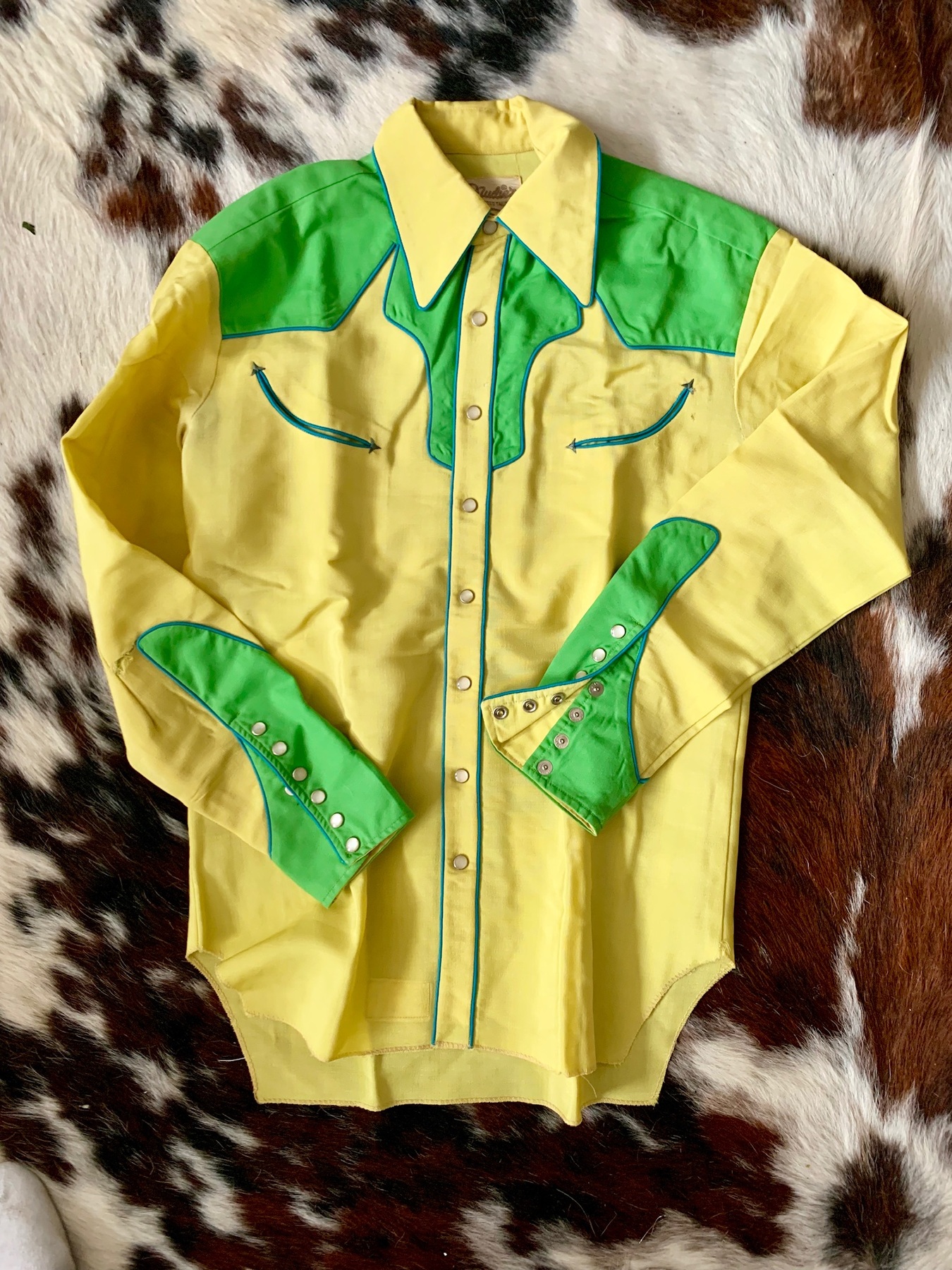
Nudie
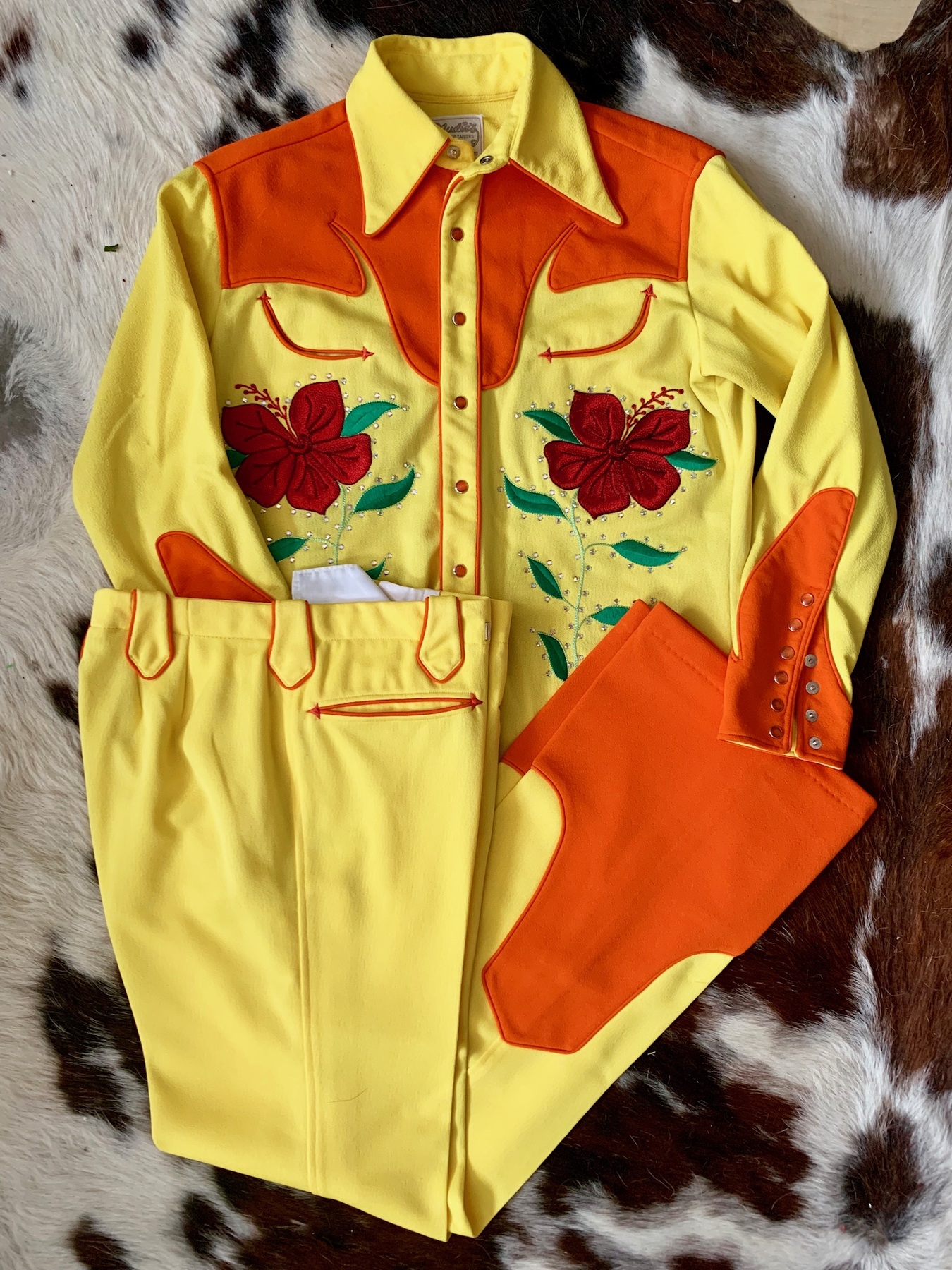
Yellow & orange suit
C01 · 1 photograph
The tailor who dressed an imagined West.
One name on the label. A whole world behind it.
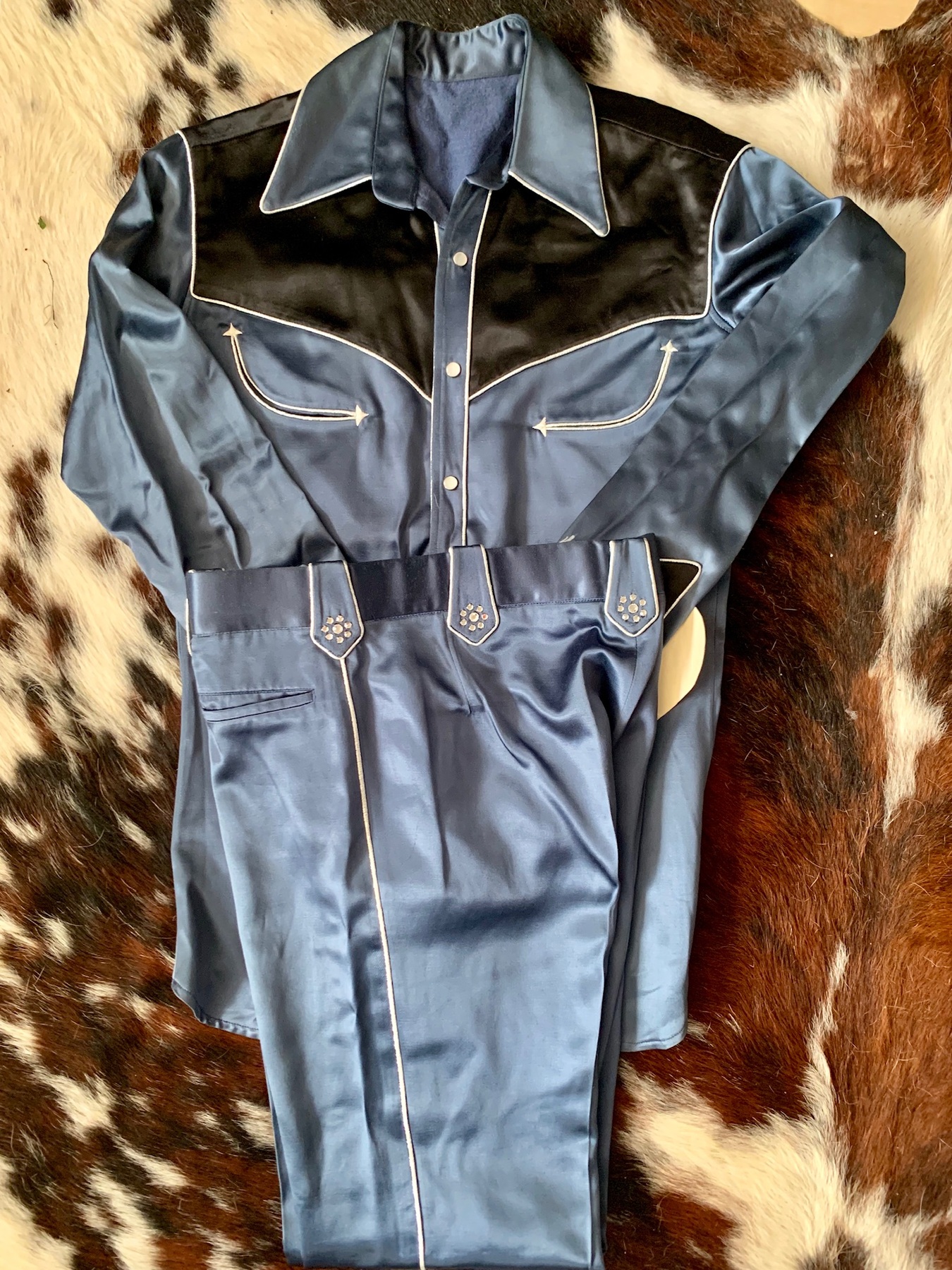
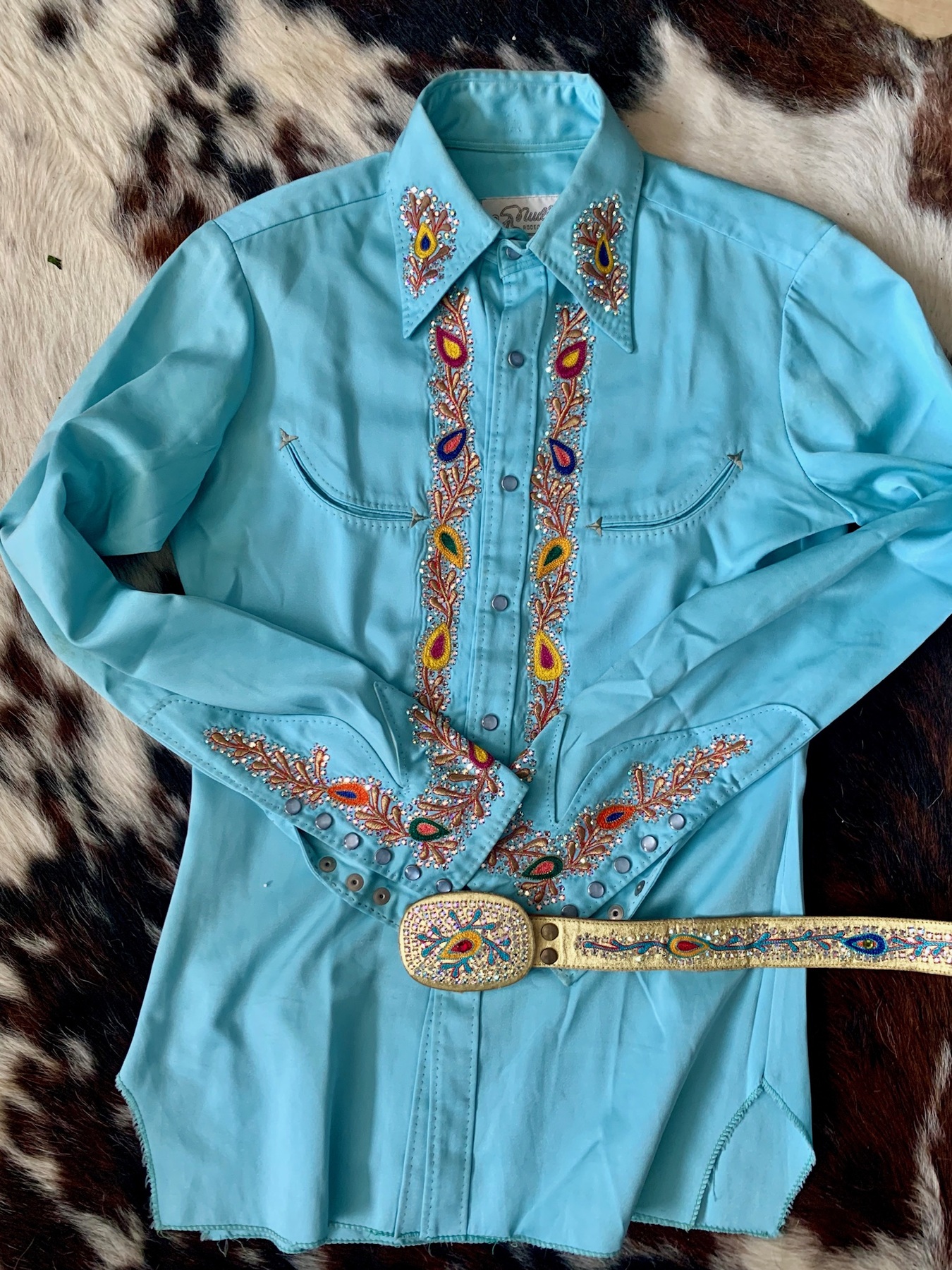
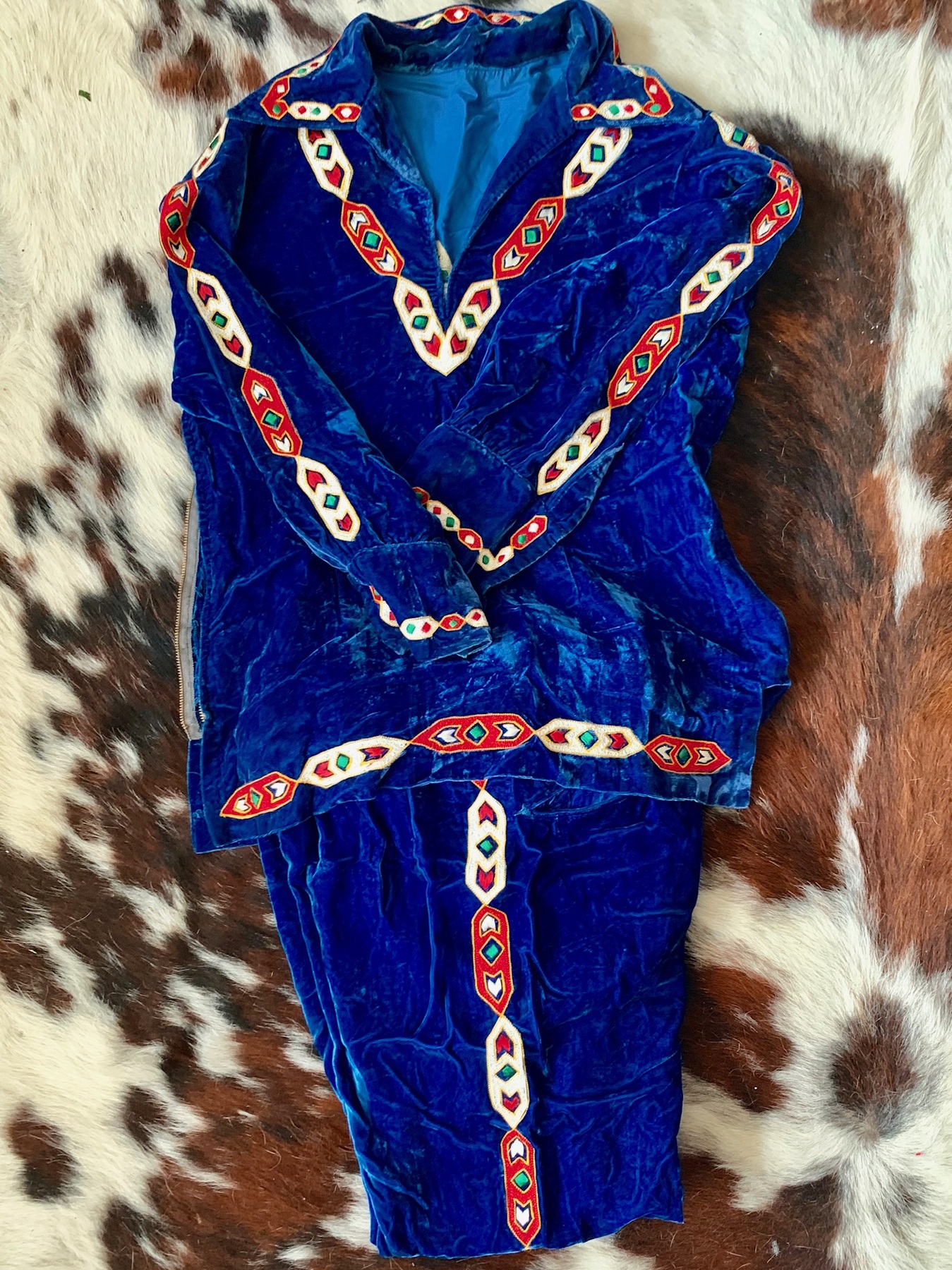
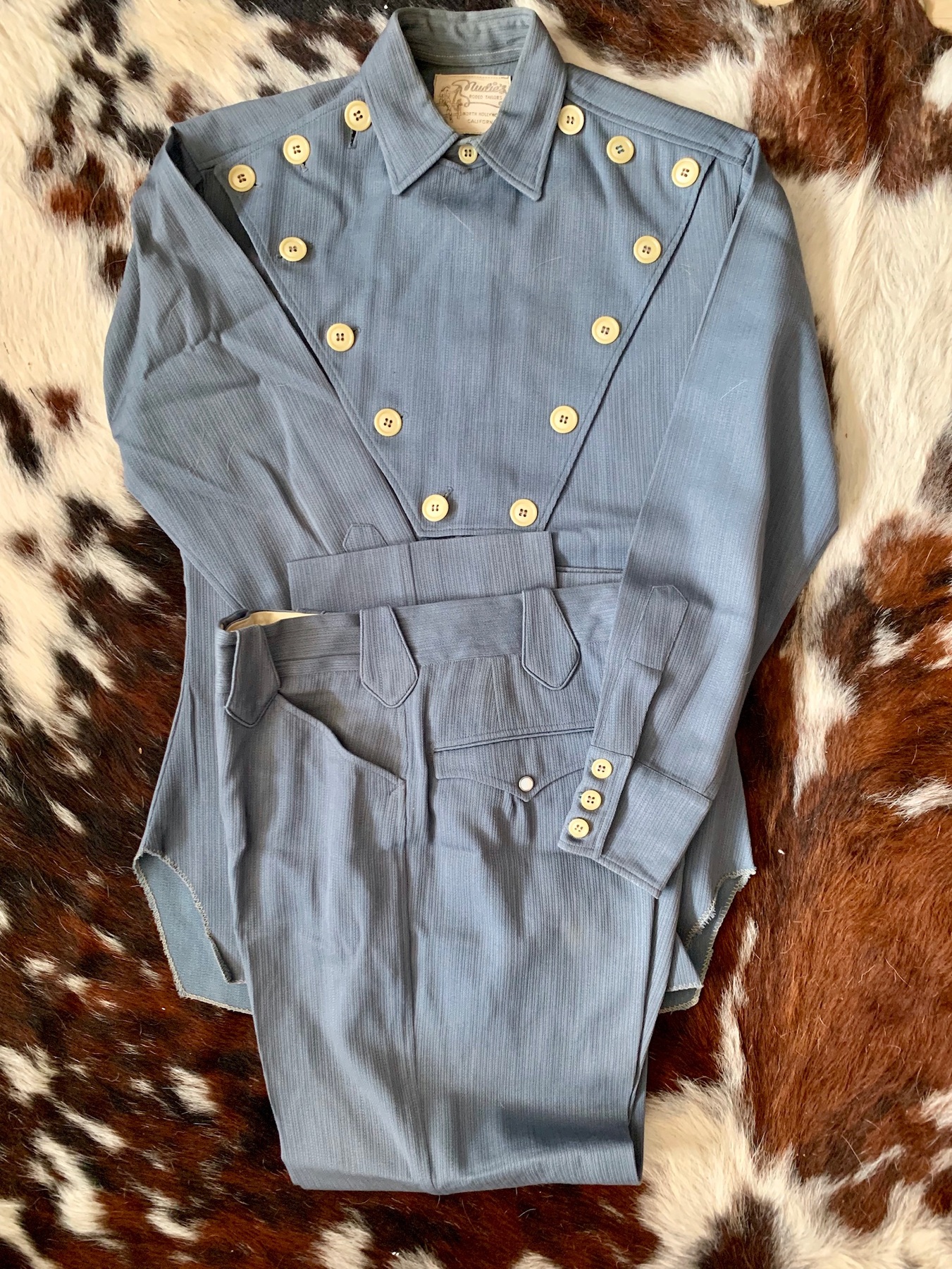
Enter the story ↓Open the catalogues ↗A Nudie outfit could turn a song into a wardrobe: a guitar embroidered across a shirt, musical notes running down a trouser leg, rhinestones catching the stage lights. The clothes were cut for performers who wanted to be recognised from the back of the room.
Roy Rogers and Tex Williams were among the customers who helped make that look famous. Behind the name was a family business, with Bobbie Cohn central to its life and a workroom of skilled cutters, tailors and embroiderers turning ideas into clothes.
Those clothes belong to a larger American story. The boy who would become the most recognisable name in rhinestone Western wear was born into a Jewish family in Kyiv, learned tailoring under the threat of violence, and crossed the Atlantic at eleven. Decades later, a singer could walk into his North Hollywood shop with a song, a rough idea and a deadline, and leave with a suit that made the song visible. The distance between those two moments is the history of a person, a partnership, a workroom and a country willing to put an immigrant's vision of its West under the brightest lights.
Follow the embroidery. Turn a suit around. Look at the boots.
Choose an outfit below, then open its details.
Inside the outfit book
Explore catalogue outfits 101 and 102, their original descriptions and prices.
Open the outfit explorer →Three catalogues. Clothes for the stage, the saddle, and the imagination. Open a volume to turn through its pages, or look closer at the portraits and outfit details.
Three catalogues, with detail photographs kept alongside their source pages.
The pale shirt, the curved rhinestone patterns, the long fringe: the outfit carries across both photographs. Whether they were taken on the same evening remains unconfirmed.
Select a view to study the same story from another angle.
Nudie was born Nutya Kotlyrenko in 1902, in Kyiv, then part of the Russian Empire. His father apprenticed him to a tailor when he was eight. Three years later, his parents sent him to the United States to escape anti-Jewish pogroms. A museum photograph identifies Nudie with his brother Julius in Russia around 1912. The photograph lets us look toward the beginning; it cannot tell us what a child thought as his family prepared to part. The trade and the journey are enough to begin.
The family shortened Kotlyrenko after emigrating. Nudie's unusual first name has its own remembered explanation: according to the Cohn family, an Ellis Island official misunderstood Nutya. It is a family story, not a surviving transcript of an immigration interview. The name stayed. Eventually it would be printed above a shop door and sewn inside clothes worn from rodeo arenas to television studios.
The appeal of his career as an American success story is obvious, though success did not erase the route that brought him there. Tailoring was skilled work learned young; anti-Jewish violence made migration urgent; the entertainment business offered a market in which a newcomer could make something nobody quite expected. Two other influential rodeo tailors, Bernard “Rodeo Ben” Lichtenstein and Nathan Turk, also came from Eastern European Jewish families and learned tailoring before settling in America. Their businesses developed distinctive ideas in different cities and served performers who wanted the West to be seen from a distance. They were participants in the making of that image, not simply suppliers to people who already knew exactly how a cowboy ought to look.
The styles owed a debt to stagecraft, movie costuming, rodeo dress and older Western clothing. They also drew on the technical knowledge and visual imagination of the people who made them. The meeting of these traditions produced garments neither an eastern European workroom nor a cattle ranch would have made alone. There is room to see cultural exchange in the result without claiming a particular embroidered flower or rhinestone pattern as a documented transplant from Nudie's childhood. The clothes themselves, and the people named in their making, tell the stronger story.
Helen “Bobbie” Kruger met Nudie in Mankato, Minnesota, where her parents ran a boarding house. Their path to a Western tailoring business was anything but straight. In 1934 they had a Manhattan business, Nudie’s for the Ladies, making costumes and accessories for burlesque performers and Broadway showgirls. The venture struggled; they also ran a dry-cleaning shop in Mankato before heading west with their daughter around 1940. Accounts disagree about where the marriage falls in that sequence and whether the move to Los Angeles came in 1939 or 1940. What they agree on is the couple’s repeated effort to find a market for the skills they had.
Those first New York customers matter to the later story. A chorus girl did not want a coat built merely to last through winter. Her costume had to shape a figure, catch the eye and survive performance. Rhinestones and showmanship were part of a paying trade before Nudie became a Western name. In Los Angeles, the couple first made sportswear. Western swing musicians gave them another opening, and they began spending time around the local bands. Clothes, music and friendship became difficult to separate.
The Tex Williams story has the scale of a family legend and the detail of a working bargain. In the Cohns' telling, Nudie offered to dress Williams's band; Williams sold a horse so they could buy a sewing machine and cloth. The musicians got suits, and Nudie and Bobbie got the means to make more. They cut and sewed in their North Hollywood garage, using a Ping-Pong table as a cutting surface. The account should be heard as the family's recollection, not a dated invoice, but the material truth of a small shop is plain: before a famous label there had to be fabric, a machine and a customer.
An existing museum photograph identifies a cream suit as one of many Nudie outfits made for Williams. Leather appliqué and rhinestones give the fabric movement even on a display stand. A separate image shows Williams performing “Song of the Rodeo” in the 1958 film Born Reckless. These images speak to the same performer and the kind of clothes he wore; they do not establish that the film garment and the surviving suit are one object.
The garage gave way to a storefront, but the earliest North Hollywood dates do not line up neatly in every retelling. The Los Angeles Times places the Victory Boulevard and Vineland shop in 1947. The Country Music Hall of Fame dates the Rodeo Tailors storefront to 1950. Angels Walk Los Angeles offers photographs it captions as the Victory counter in the late 1950s and an earlier Hollywood shop in the early 1940s, while its text also gives a 1947 move to Victory and Vineland. These are different kinds of evidence—later family reporting, museum synthesis and a walking-guide caption—and the photographs deserve to be seen even while the chronology remains under study.
Nudie was already a public figure beyond the counter. A newspaper correspondent visiting a Palm Springs parade in 1948 reported that a judge in the “Sweetheart of the Desert” contest went by the title “Nudie the Rodeo Tailor.” It is a small notice, but it catches the business identity moving into the world of parades, publicity and performers. By 1960 a country-music trade annual listed the shop at 11000 Victory Boulevard, describing its Western clothes for film and television personalities. By 1954, the enterprise employed fourteen people. In 1963 it moved to larger premises at 5015 Lankershim Boulevard.
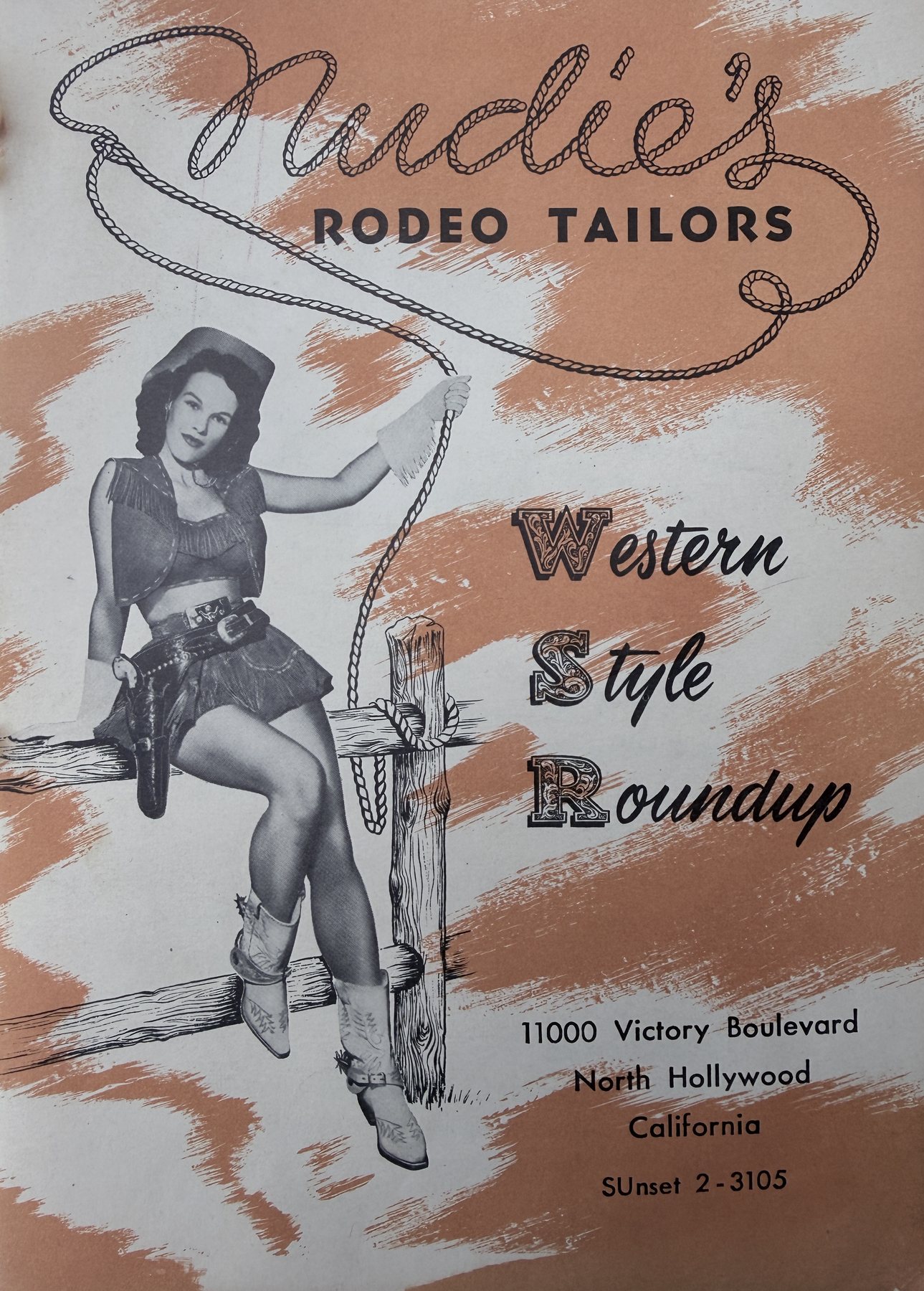
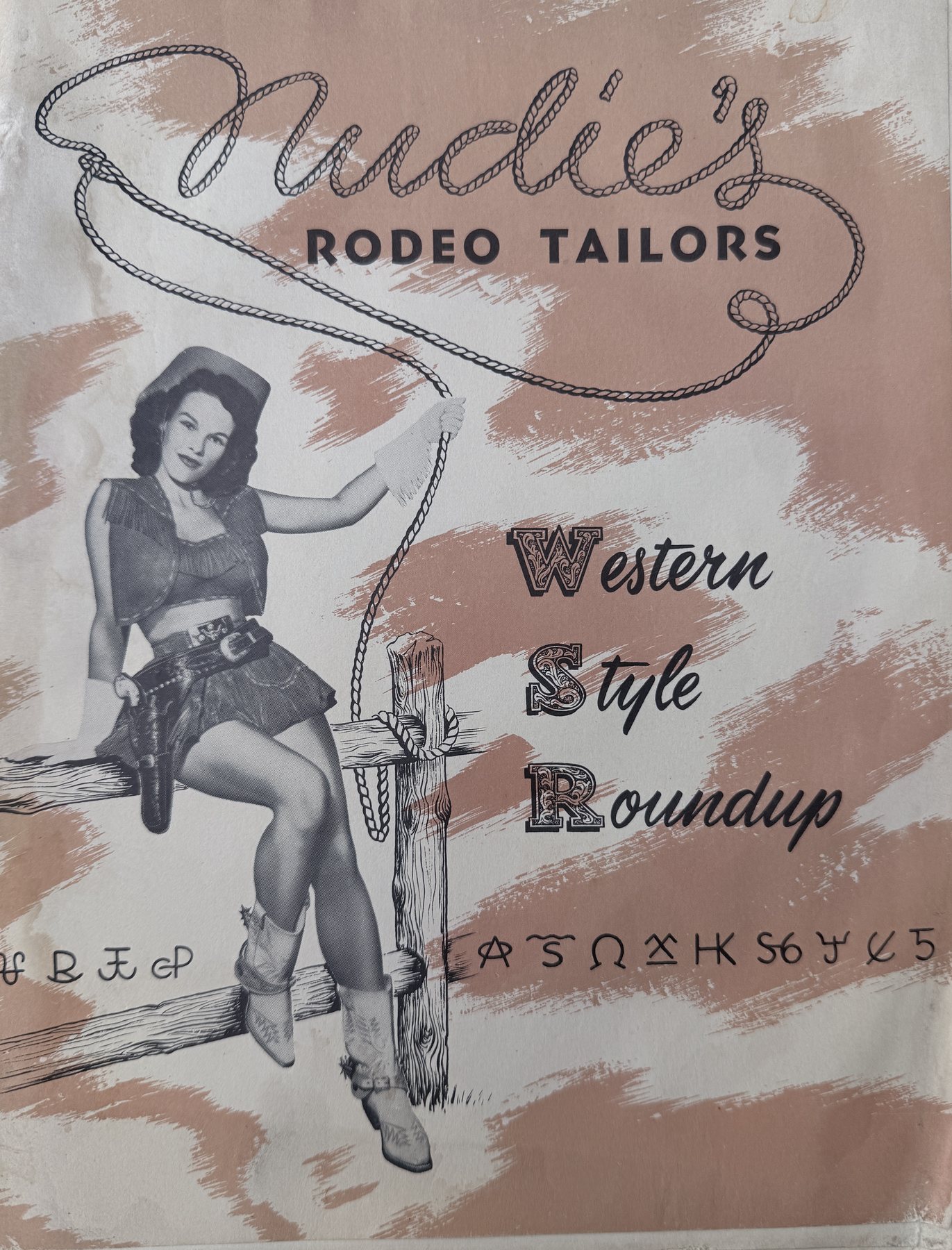
The later storefront says something about the business without our having to imagine a scene inside it. The sign announces Nudie's Rodeo Tailors and “Everything for the Horse & Rider.” Its panels offer boots, leather vests, Western shirts, made-to-order suits, hats, blankets and belts. Two surviving Western Style Roundup covers at the Autry print the same Lankershim address. A catalogue could travel where the shop could not; a customer could turn a page, choose a line or a motif, and send an order back to North Hollywood. The Autry dates its two copies broadly rather than assigning a precise year, so the address is firm evidence of location, not a catalogue issue date.
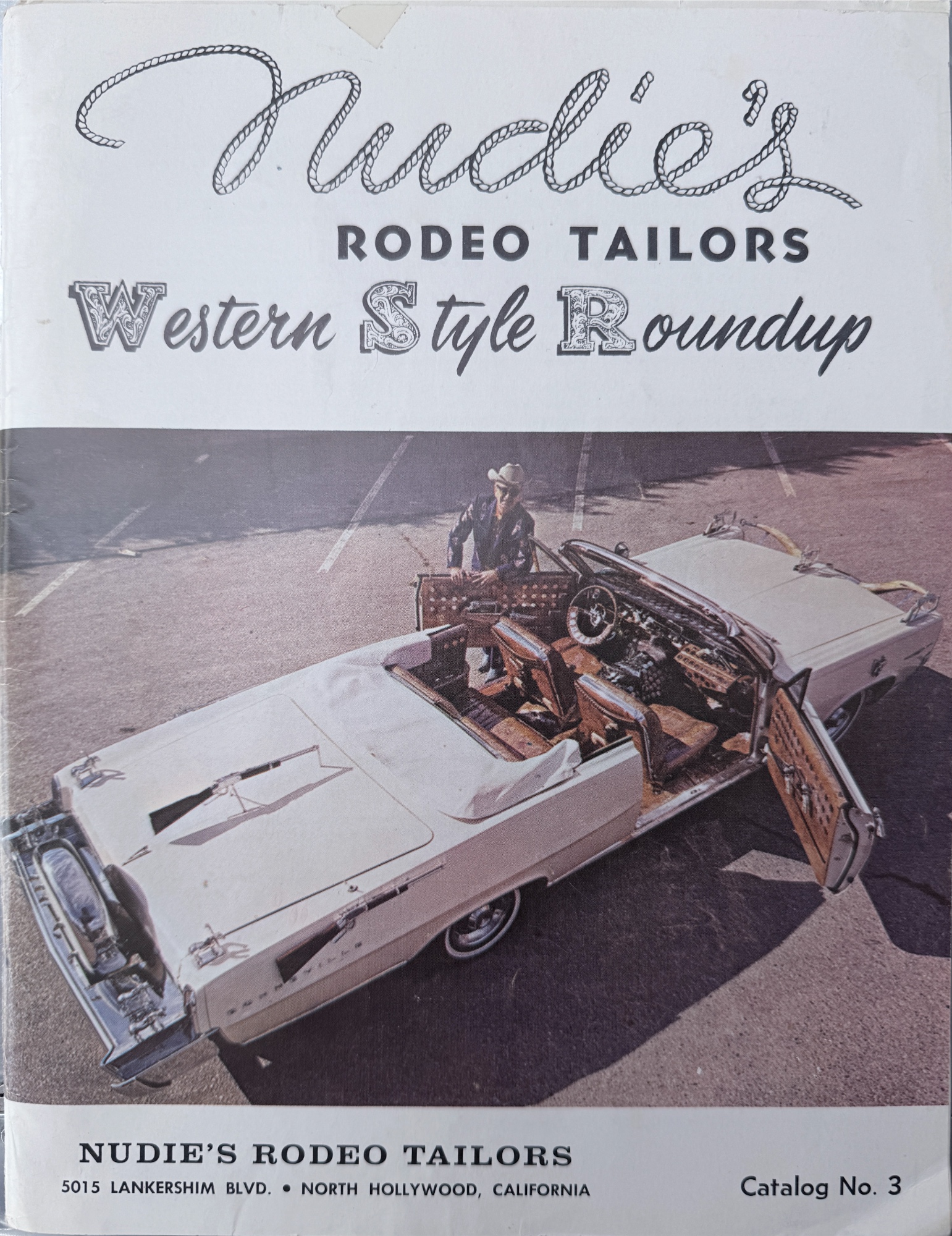
Two photographed covers make the shop's changing address tangible. One prints 11000 Victory Boulevard and a SUnset telephone number beneath a roping figure. Another calls itself Catalog No. 3, prints 5015 Lankershim Boulevard, and places a decorated convertible across its lower half. They are two ways the shop introduced itself to a customer before the first page was turned. Neither cover supplies its issue year.
The owner-held catalogues widen the picture further. Famous customers fill some pages; other pages offer shirts, skirts, boots and a new way into the workroom for somebody who had never stood at its counter. One Victory Boulevard catalogue tells a customer to have a nearby tailor take measurements, then send them to North Hollywood with the desired style number, a deposit and a sample. It asks for height, weight, hair and eye colour, and the customer's line of work, so that the clothes could be suited to the person and what they did. The shop said it would keep those measurements for later orders. The rhinestone suit was a spectacle, certainly, but here is the less visible arrangement that could bring one into being: a customer, another tailor, an envelope and the shop's own records.
The price sheets make the choices equally plain. The women's list offers a gabardine gore skirt for $30, the same basic garment with fringe for $50, or with fringe and rhinestones for $75. It also names divided skirts and boleros. On the men's list, complete hand stitching for a coat-and-trousers suit costs another $20. These are undated printed asking prices, not invoices, but they show how material, skilled labour and dazzle entered the bargain at different points. “Nudie suit” now suggests one kind of blinding stage garment; the catalogue gives the customer a range of ways to dress and a price for making the entrance bigger.
A model on a rail fence, one hand raised to the rope that spells out Nudie’s name. The catalogue put its own version of the West on the cover before a customer had turned a page.
Open the figure to see her in the complete cover design.
Bobbie helped turn that widening offer into a functioning business. Family accounts describe her welcoming customers, taking orders, keeping the books and helping judge how much embroidery or rhinestone work a suit needed. The Autry's files preserve the less visible labour around the clothes: customer correspondence, drawings, fabric swatches, boot records, bills and payment papers. In a shop selling made-to-order imagination, someone had to convert a customer's idea into measurements, material, a price and a date. Nudie's public personality brought people through the door; Bobbie helped see that their clothes came out of it.
A Valley Times photograph catches them at Sportsmen's Lodge in 1958, celebrating their twenty-fifth wedding anniversary. The newspaper caption credits Bobbie as a major factor in Nudie's success. An owner-held photograph shows her beside an early Nudie Mobile in a fringed Western suit and boots. She was present in the accounts and in the visual theatre of the firm. Later, when Nudie died, she would also decide how long the shop continued and where its papers would go.
The printed family portrait on the catalogue page belongs here too. Its caption brings Barbara into the same public story as Bobbie and Nudie. The picture alone cannot itemise anyone's work, but it refuses the idea that a shop is only the man whose name is on its sign.
The rhinestones did not arrive as a fixed rule for country music. The Hall of Fame dates a decisive encounter to 1951, when Nudie made Lefty Frizzell an outfit with a few stones. Frizzell noticed the audience response and asked for more on later orders. An early shirt in the exhibition has long contrasting suede fringe, piping, six-snap shotgun cuffs and initials outlined in rhinestones. Boots spell his name in red and green stones. Those are not random additions. A singer could turn toward a balcony and still be identified.
The performer and the tailor were shaping an image together. Hank Snow offers a particularly intimate piece of evidence: a letter describing the colour he wanted and the trains he imagined on his coat. The suit made his 1950 hit “I'm Moving On” visible with locomotives and lanterns. Snow's wardrobe extended far beyond one clever garment—museum holdings include nautical embroidery, tropical birds, blue lamé, houndstooth, bolero jackets, shirts and boots. The range complicates the shorthand that every Nudie customer came back for the same trick. They came with their own lives, songs and audiences.
Hank Williams wore a musical-note suit whose rear view carries a guitar and notes across the cloth. The museum's performance photograph, dated around 1952, shows such clothing at work before an audience. Seen on a mannequin, the embroidery can be examined. Seen in a performance image, the same kind of suit belongs to a singer's moving body and the people who came to hear him. A separate owner-held picture shows Williams with an electric guitar in a piped, fringed Western shirt; its owner attributes the shirt to Nudie's shop, but the photograph alone has not yet verified its maker. Both images can be valuable without asking either to establish more than it shows.
Nudie's shop learned to make a performer's public identity readable as a picture. T. Texas Tyler's “Deck of Cards” appeared as playing-card embroidery on a jacket. Viola Grae made the scene for Hank Thompson's “Humpty Dumpty Heart” boots. Webb Pierce's jailhouse suit took its imagery from “In the Jailhouse Now.” Porter Wagoner could wear wagons. On Ray Price and his Cherokee Cowboys, the name became another pictorial source. That last group also shows the limits of innocent nostalgia: some designs drew on stereotyped depictions of Native Americans and objects associated with them. The historical garment can be examined closely without adopting its fantasy as a true account of Native cultures.
The pictorial clothes worked because the tailoring beneath them could carry the picture. A jacket had to fit across shoulders while its design read from a distance; trousers had to leave room to move; boots had to hold their shape. Rhinestones could flash, but the workroom decided whether the performer could wear that flash through a show. The exhibition preserves sewing equipment, a bootjack and a steam iron. The tools bring the stage image back to time spent cutting, stitching, pressing and fitting.
Women wore the shop's work in several registers. Cindy Walker's early-1950s shirt and split skirt use shaped lines, piping and pointed pockets rather than a crowded pictorial field. The women's price list offered gabardine and leather skirts, divided skirts, boleros and a four-piece “Cover Girl Suit.” Actress Gail Davis's pink outfit later entered Emmylou Harris's wardrobe, according to the Hall of Fame, when Harris bought it while touring with Gram Parsons. A garment made for one person's role could acquire another life on a different stage. The museum text spells Gail's name “Gale”; her identity deserves the corrected spelling in the narrative and a note in the record.
Roy Rogers was one of the people through whom Nudie's work met the broadest Western public. His face beside Nudie's in the catalogue roundel is a shop image of a relationship; it cannot inventory Roy's clothes by itself. The museum's 1962 portrait places him alongside Nudie, Tex Williams, Gene Autry and Rex Allen. Individual sale and collection records from the Rogers and Dale Evans holdings preserve further garment and label evidence, but each object must carry its own attribution and provenance. That distinction matters in a wardrobe as large and varied as Roy's. The printed portrait can introduce the relationship, followed by the specific garments the archive can actually document.
The business dressed more than musicians. An Autry shirt for Gene Autry's personal appearances survives with red piping and snaps, an American flag and the pre-1965 Canadian Red Ensign embroidered on its bib. A 1956 two-piece Western business suit for the broadcasting executive Connie B. Gay carries stitched pocket details and arrows; the Smithsonian says he wore it on television and, according to friends, at home. These garments move from rodeo and film to broadcasting and personal life. They also remind us that an entire Western look might combine several makers: the Autry credits one women's ensemble's shirt and trousers to Nudie's, while its hat, boots, belt and scarf came from other specialists.
The commission for Elvis Presley's gold lamé stage suit made the reach of Nudie's work plain beyond country music. Graceland attributes the 1957 suit to Nudie's shop and says Colonel Tom Parker commissioned it. Its gold jacket became a durable part of Elvis's early stage image; the museum records its later use at the 1961 Pearl Harbor benefit. On another front, a shop serving a new generation of rock musicians could also dress a performer such as Johnny Cash in a Bicentennial suit, eagles and stars made part of a national-anniversary appearance. The clients were different. The question the shop answered was recognisable: what could cloth do for a public figure standing before a room?
Nudie did not only sell clothes to musicians. He played mandolin. Kosmo Cominos remembered walking into the shop to find Nudie and friends jamming; his account, published in Vintage Guitar, also follows a custom Mosrite electric mandolin made for Nudie. Don McGinnis, whose band played the San Fernando Valley circuit, recalled that Nudie would come to places including the Palomino and the Cowboy Palace and join them on the instrument. A 1984 Billboard obituary reports that he recorded an album, Nudie and His Mandolin, for his own label in the mid-1970s. Those three sources give us a musical life larger than a shop owner's fondness for hanging around stars. They do not place him in every jam named in later reminiscence, so each scene stays with the person who remembered it.
The same music circle appears in contemporary trade reporting. In February 1953, Cash Box described new wardrobe for Bob Wills and his band: blue suits trimmed in white for the musicians, red-and-gray boots and white hats, while Wills wore black trimmed in white. This was a coordinated group image, reported while current rather than reconstructed from a sale years later. In 1954, Roy Rogers, Tex Williams and Rex Allen organised a testimonial luncheon for Nudie, announced by Billboard and later reported held by Cash Box. One newspaper item, one outfit, one gathering at a time, the trade record shows the relationships on which the shop depended.
That public sociability could also become an order book. Record World reported him taking clothing orders at a hotel gathering in 1966. Cash Box placed him at Judy Lynn's Las Vegas debut in 1970 to approve a special costume. A 1976 trade caption associated Nudie with ZZ Top's stage outfits. It would be easy to turn these notices into a single undifferentiated list of celebrities. More revealing is the continuity in the work: he sought out artists, listened to what they wanted to project and kept the shop close to the musical life it served.
Four portraits of Nudie from the back of catalogue three. Different colours, different embroidery, the same unmistakable figure.
Nudie's was an immigrant-owned California workroom, staffed by people whose own journeys and skills shaped what came out of it. Bobbie managed orders and accounts. Viola Grae worked with chain-stitch embroidery in the shop's early years and is specifically credited by the Hall of Fame for Hank Thompson's boots. Rose Clements became its master embroiderer after arriving in Los Angeles in 1963. Manuel Cuevas worked as a designer; Jaime Castaneda was a tailor. Bootmakers, leather workers and alterations workers belonged to the same production story. The staff's lives do not disappear because a label says only “Nudie's.”
Cuevas and Castaneda had migrated from Mexico, bringing tailoring knowledge learned in their home communities. The Hall of Fame places them in a later generation of Western makers who adapted the established techniques and imagery to their own ideas. Nudie and Nathan Turk were not the whole picture, nor were the women and Mexican workers merely anonymous hands executing a single man's vision. An honest account names individual contribution where a source can show it, and records the limits of those credits where an object or surviving account cannot.
The Flying Burrito Brothers' suits, ordered in the late 1960s, make that collaboration visible. The musicians chose colours, cloth and images with Cuevas. Gram Parsons's white suit joined flowers and a cross to darker emblems of the band's “Sin City” world. The other three designs carried roses, dinosaurs and the sea. A later account places Rose Clements among the shop workers associated with the commission, though it does not establish who embroidered a particular section. The four are celebrated as “Nudie suits”; their making involved decisions by performers, designer, tailors and embroiderers.
One Burritos suit shows why a garment's life after delivery belongs in the story. Chris Ethridge's rose-covered white suit was reported stolen and returned to the shop in 1969. Elton John bought it in 1970, wore it on Top of the Pops in 1971, and it appeared on a British “Rocket Man” sleeve the following year. Decades later, Ethridge's daughter Necia acquired it at auction and lent it for a reunion display with its three companions. A name inside the clothes helped reconnect the object to the man for whom it was first made. The suit was never only a museum illustration of country rock: people kept choosing it, losing it, finding it and giving it new meanings.
Other Western-wear makers worked in the same broad world. Nathan Turk had his own Los Angeles business and performer clientele. Marge Riley built a separate Western-clothing practice, with a Los Angeles shop and later Palm Springs presence documented in period sources. Claims that particular makers worked for one another, or that Viola Grae freelanced for every shop that paid, need a named commission, label, payroll record or attributable recollection before appearing as settled fact. The larger point is already visible: the fantasy cowboy was often made in urban workshops by immigrants, women and skilled specialists, not by the solitary ranch hand he seemed to depict.
Nudie understood his own effect on a room. A circa-1970 outfit in the Autry's collection, identified as his, uses off-white wool gabardine, flame-like orange, red and yellow embroidery, silver beads and rhinestones. Its front and back deserve to be seen together. This was not only an advertisement for what a customer might buy. It was a tailor wearing the powers of his shop openly, asking the public to take delight in them. The Autry records Bobbie as donor of the garment; one family's wardrobe became historical evidence through another act of care.
The Nudie Mobiles carried that impulse into traffic. Owner-held promotional pairs show him beside a Cadillac El Dorado, a Pontiac Grandville and a Pontiac Bonneville, each accompanied by printed shop copy. Saddles, horns, tooled leather, silver dollars and pistol-shaped fittings turned a car into a travelling display. The publicity pages also name some of the people who carried out leatherwork and fitting. Their figures and flourishes are claims made by the shop; the photographs show what was presented. Here, too, the celebrity name gathered attention around many forms of practical labour.
The shop's stationery, stickers and gift certificate belong beside those cars, not beneath the notice of a fashion history. They show a business creating a world that a customer could carry home. So do the catalogues with their pricing and ordering directions. At one scale the brand was a man in a bright suit; at another it was a clerk taking an order, measurements kept for a later one and an addressed envelope moving through the post.
Nudie died in 1984. Bobbie continued the Lankershim business with their daughter Barbara and granddaughter Jamie, drawing on patterns the shop had kept. A decade later, the store closed. In a 1994 Los Angeles Times report, Bobbie said she wanted to wind it down while she was alive rather than leave it to someone else. The decision had weight. A custom tailoring shop could not be passed on merely by keeping its sign and its patterns; it had depended on particular people, their judgements and their relationships with customers.
That year Helen B. Cohn donated Nudie's business papers to the Autry. The archive now described in sixty-four boxes contains bills, boot and clothing records, correspondence, photographs, publications, drawings and fabric swatches. Individual customer files make up much of it. A garment that looked almost magical under stage lights began with choices a researcher can sometimes still trace on paper: a fabric, a sketch, a measurement, a cost. The archive is no replacement for the voices of every worker and customer; it gives those lives more chances to be found.
The clothes themselves have travelled. Hank Snow left a substantial stage wardrobe to a museum. A Nudie suit worn by Belgian performer Bobbejaan Schoepen is held by MoMu; the larger Bobbejaan and Josée collection later supported Antwerp's Dream Suits exhibition and conservation work. A label in a Roy Rogers and Dale Evans Museum Collection sale, a suit photographed for Ray Price in a Texas display, and a privately held catalogue page all add different kinds of evidence. No single repository owns the whole story.
The familiar phrase “Nudie suit” can flatten that story as quickly as it makes the clothes famous. Look closely and the name opens outward: to a boy trained in Kyiv, a couple willing to try again after a business setback, a band that bought their first machine, a wife who kept the books, women and immigrant workers who designed and made, musicians who chose their own images, and later keepers who saved garments and papers. A rhinestone is only a little piece of glass until a person places it where light, music and movement can give it a job. Nudie saw that possibility. Many people helped make it real.
---
The Country Music Hall of Fame holds a red lace-front shirt and matching trousers attributed to Nudie’s Rodeo Tailors for Lefty Frizzell. Piping, smile pockets, arrow stitching, leather fringe, six-snap cuffs, rhinestones and felt-appliquéd guitars and notes make the ensemble legible close up. The museum records its use on the cover of 1959’s The One and Only Lefty Frizzell; that dates the public image, not necessarily the making of the clothes.
A 1964 Country Music Review caption gives another, narrower connection: it pictures National Finals Rodeo queen Joyce Redd visiting “Nudie the cowboy tailor” and says he made her outfit. The caption joins wearer, garment and shop name, but does not identify the person who designed, embroidered or constructed it.
From Joe’s archive
A wardrobe, a circle of customers, a life around the shop. Open any photograph to look more closely.
David Browne’s retrospective account names Jaime Castaneda in the early Flying Burrito Brothers commission. Castaneda’s own studio history dates his arrival in Los Angeles to 1974. His participation in the earlier commission is not treated here as established.